
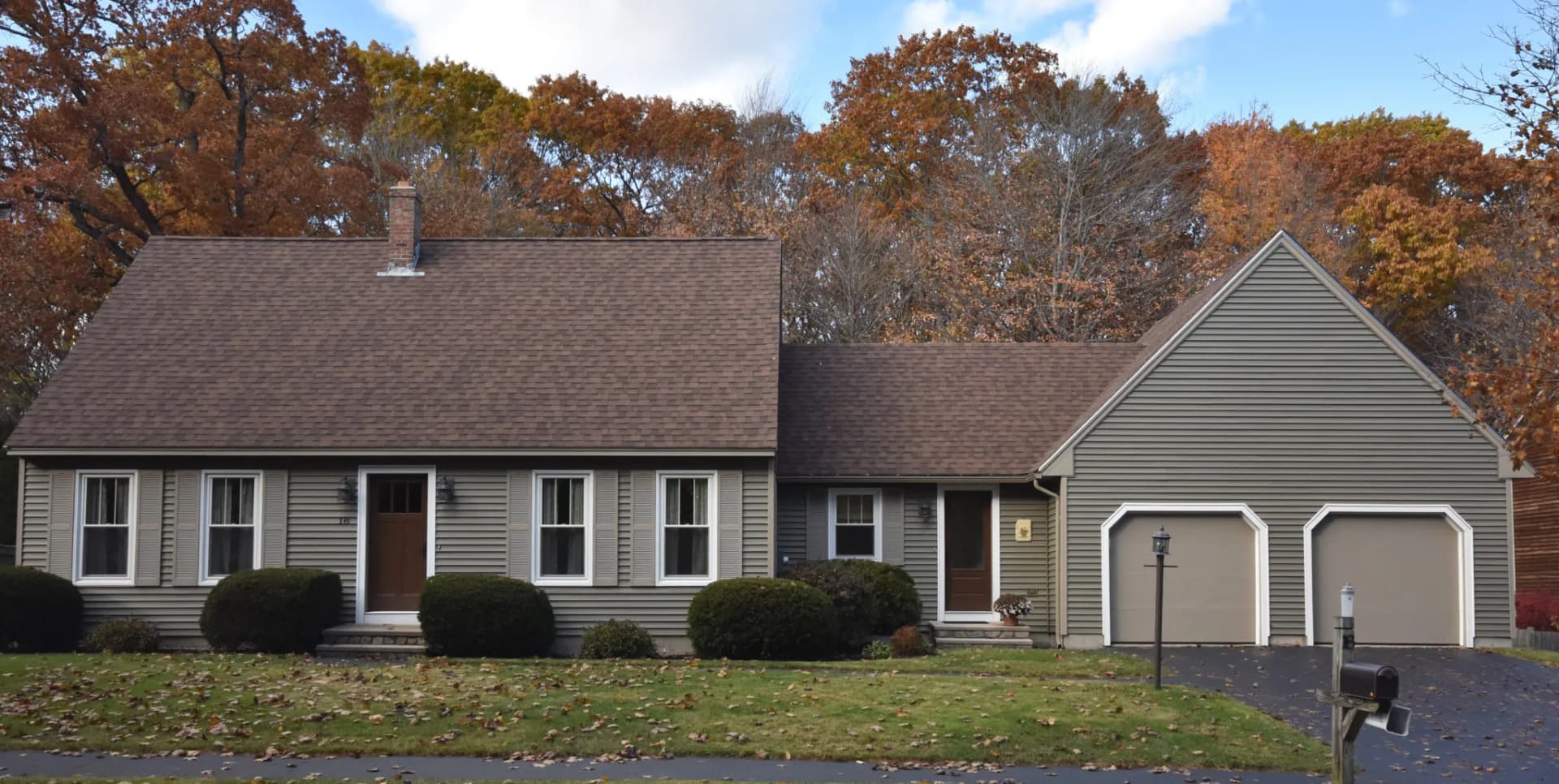
Vinyl Siding Installation in Freeport, Maine
Vinyl Siding Installation for Freeport homes from a family-owned Portland company. An owner measures on site and writes a fixed-price proposal.
- 5.0 · 8 Google reviews
- Fully licensed & insured
- Free estimates
- 20+ years combined experience
Vinyl Siding Installation for Freeport homes
Premium vinyl makes the most sense on the houses Freeport has added since the 1960s: ranches, split-levels, garrison colonials and the roughly 30 percent of homes built in 2000 or later. A thicker panel with a rigid foam backer resists the dents that thin siding picks up from hail, ladders and lawn equipment, and it holds a straighter line across long walls. Color choices now include deep greens, grays and blues formulated to hold up in strong sun far better than the pale panels of the 1990s, and the backer adds a little insulating value to the wall.
Wind is the thing to specify for near the water. Along Wolfe's Neck, South Freeport and the Harraseeket shore, ask for a panel with a high wind-load rating and a locking top hem, hung loosely enough on its nails to expand and contract through Maine's swing from January cold to August heat. Vinyl turns brittle in deep cold, so cutting and hanging it is best done when temperatures allow. On a Federal or Greek Revival house in the Harraseeket Historic District or along Main Street, vinyl changes the look of wide corner boards, cornice returns and window casings, and fiber cement or cedar usually keeps those proportions intact.
Freeport housing at a glance
Census estimates (ACS 2020-2024) put Freeport at roughly 4,250 housing units with a median year built of 1984, young for a town incorporated in 1789: about 17 percent of homes predate 1940 and about a quarter predate 1960; another 18 or 19 percent went up between 1960 and 1979, and roughly 30 percent were built in 2000 or later, leaving about a quarter from the 1980s and 1990s. Around 72 percent are single-family detached houses, close to 78 percent of occupied homes are owner-occupied, and some 280 units are held for seasonal use. The oldest stock is Federal and Greek Revival: the c. 1790 Mitchell-Soule-Davis cape and the c. 1830 brick Harrington House survive on Main Street, and saltbox farmhouses such as the Pettengill House and the Capt. Greenfield Pote House stand near Mast Landing and on Wolfe's Neck. Newer neighborhoods fill in between Route 1, I-295 and the river.
Weather and exposure in Freeport
Freeport sits at the northeastern corner of Casco Bay, and the Harraseeket River carries the tide inland past South Freeport, Porter's Landing and Mast Landing. Houses on Wolfe's Neck, in South Freeport and along the river take salt air, fog and northeast wind off the bay in nor'easters, while homes west of I-295 sit in more sheltered, wooded country. Snow is a real load here: Portland International Jetport, the nearest long-record weather station, averages about 69 inches a season under the 1991-2020 normals, most of it from December through March. Winters swing above and below freezing again and again, so water that gets behind trim, into siding joints or under shingles freezes, expands and works deeper with each cycle. Ice dams form on poorly insulated older roofs.
Permits and design review in Freeport
Building permits come from the Codes Enforcement office at Freeport Town Hall, 30 Main Street. A permit is required for any structural work or change of use, alterations may need one too, and the town asks owners to check with the codes officer first; a complete residential application is usually approved within a week. The residential checklist asks deck applicants for pier locations, framing, fastening, guards, handrails and stairs, and asks for a window and door schedule with U-factors. Downtown renovations fall under the Design Review Ordinance and the Project Review Board, and land within 250 feet of tidal water or a coastal wetland is in the state shoreland zone.
What vinyl siding installation involves
Premium vinyl siding is the fastest way to a tight, low-maintenance exterior. Today's thicker panels come in clapboard, Dutch lap, board-and-batten and shake profiles and in colors that were not possible a generation ago. The projects shown on this site include CertainTeed Monogram vinyl siding, used to replace rotting wood clapboards and 1970s metal siding on Portland homes. Vinyl moves with temperature, so how it is hung matters as much as which panel you pick.
- Old siding is removed and the wall is checked for soft sheathing and past leaks.
- House wrap and flashing go on first, with extra care around windows, doors and roof-to-wall joints.
- Starter strip, J-channel and corner posts are set straight and level so every course lines up.
- Panels are nailed in the center of the slots and left loose enough to expand and contract through a Maine winter and summer.
- Trim is wrapped or replaced with low-maintenance millwork so there is nothing left to paint.
Signs it is time
- You are tired of repainting wood clapboards every few years
- The existing vinyl is faded, cracked, or loose after wind storms
- The budget needs a whole-house result rather than one premium wall
- You want an insulated panel to take the edge off drafty walls
What affects the price of vinyl siding installation
- Panel grade and thickness, and whether it is insulated
- Profile: clapboard, Dutch lap, board-and-batten or shake
- Amount of trim, soffit and fascia wrapped or replaced
- Tear-off and sheathing repairs
- House height and access
Every job is priced from a free on-site visit. Typical ranges for the trade are on our siding page, and the details of this service are on the vinyl siding installation overview.
More in Freeport and nearby
Back to the Freeport exterior services overview, or see every town on our Cumberland County service areas page.
Other exterior work in Freeport
- James Hardie Fiber Cement Siding in Freeport
- Cedar Siding & Shingles in Freeport
- Window Replacement in Freeport
- Bay & Picture Windows in Freeport
- Roof Replacement in Freeport
- Asphalt Shingle Roofing in Freeport
- Metal Roofing in Freeport
- Deck Building in Freeport
- Composite & PVC Decks in Freeport
- Deck Replacement in Freeport
- Siding Replacement in Freeport
Get a free vinyl siding installation estimate in Freeport
Tell us about the house and what you want changed. One of the owners will call to set up a visit, measure, and write a fixed-price proposal. No pressure, no obligation.
Need it today?Call Mike (207) 408-5388
or Bob at (207) 252-0759