



Composite & PVC Decks in Saco, Maine
Composite & PVC Decks for Saco homes from a family-owned Portland company. An owner measures on site and writes a fixed-price proposal.
- Google reviews
- Fully licensed & insured
- Free estimates
- 20+ years combined experience
Composite & PVC Decks for Saco homes
Composite and PVC decking suits Saco's coastal exposure well. Salt spray at Camp Ellis and Ferry Beach, along with months of snow cover, wear down wood decking fast and demand more sanding and restaining than most owners want to keep up with. A low-maintenance composite deck means a beach house can sit closed over the winter and be ready to use again each spring with just a wash.
Composite still needs to be engineered correctly for Saco's temperature swings, with proper gap spacing at butt joints and edges so the boards can expand and contract without buckling. The framing underneath is still typically pressure-treated lumber and has to meet the same footing and frost-depth requirements as any other deck. On an ocean-facing deck, darker composite colors run hotter underfoot in full summer sun, which is worth factoring into the color choice for a beach property.
How a Deck Structure Is Built
- Footing — poured below Maine’s frost line so winter heaving cannot move it
- Post — carries the beam load down to the footing
- Beam — spans between posts and carries the outer ends of the joists
- Ledger — bolted to the house framing, with flashing that diverts water away from the wall
- Joists — span from the ledger to the beam, sized and spaced to the decking and the load
- Decking — the walking surface, fastened on top with spacing for drainage
Saco housing at a glance
Census estimates put Saco's median home built around 1982, with about 22 percent of the housing stock older than 1940 and roughly a third older than 1960. That mix reflects two different building eras: modest worker housing and duplexes from the York Manufacturing and Saco-Lowell mill years clustered near downtown and Factory Island, and a much larger ring of capes, colonials and split-levels built from the 1960s onward as Saco filled in along Route 1 and Route 112. At Camp Ellis and Ferry Beach, small older cottages sit alongside newer, larger houses built up on pilings after decades of storm damage.
Permits and design review in Saco
Building permits in Saco go through the Code Enforcement Department at City Hall on Main Street, which handles siding, roofing, window and deck permits alongside other building work. Because Saco has both river and ocean frontage, Maine's Mandatory Shoreland Zoning Act applies within 250 feet of the Saco River and the Atlantic coastline, which affects what can be built or rebuilt at Camp Ellis, Ferry Beach and along the riverbanks. Property near the water may also fall under FEMA flood-zone rules, which matters most for deck framing and any work that touches the foundation.
Weather and exposure in Saco
Camp Ellis takes the brunt of Saco's weather. A 19th-century Army Corps jetty at the river mouth has driven well-documented beach erosion there, and nor'easters push storm surge and wind-driven rain straight at the row of houses along Ocean Avenue. Winters bring damaging freeze-thaw cycles and a snow load that has to be planned for on any roof, while salt air off the Atlantic and the Saco River estuary accelerates corrosion on fasteners, flashing and gutters closer to the water. Inland, away from the coast, the exposure is a more ordinary Maine winter, but ice damming at the eaves is still a factor on any roof with poor attic ventilation.
Saco at a Glance
What the housing stock and local code enforcement mean for a siding, window, roofing or deck job here.
20,819
Population (ACS estimate)
Median year built: 1982
Mostly vinyl or fiber-cement siding and insulated replacement windows from recent decades.
State Building & Energy Code (MUBEC)
Enforced — population over 4,000
EPA Lead-Safe Rule (pre-1978 homes)
Applies to at least 32% of homes here
Shoreland Zoning
Applies near the water
Permits
Saco Code Enforcement Department
Codes & Permits for Composite Decks in Saco
In Saco, exterior-work permits come from the Saco Code Enforcement Department (300 Main Street, Saco, ME 04072, (207) 284-6983). With 20,819 residents, over 4,000, Saco is required to enforce the Maine Uniform Building and Energy Code (MUBEC).
- Maine's adopted 2021 IRC (R507.2.2) requires plastic composite deck boards, stair treads, guards, and handrails to comply with ASTM D7032, and (R507.2.2.1) to be labeled with the allowable load and maximum allowable span determined under ASTM D7032 — meaning composite span limits come from the product's own ASTM D7032 listing/manufacturer data rather than the standard wood joist-span tables, and are often shorter, requiring closer joist spacing than an equivalent wood board. up.codes
- Composite decking installation must follow both the code and the manufacturer's instructions (R507.2.2.5), so a given product's specific fastening pattern and joist spacing should be pulled from its ICC-ES evaluation report or manufacturer install guide, not assumed from a generic wood-deck spec. up.codes
- Maine's Shoreland Zoning Act creates a regulated shoreland zone extending 250 feet (horizontal distance) from the normal high-water line of any great pond, river, or coastal wetland, and 75 feet from certain streams; the Act's stated purposes include protecting buildings and land from flooding/erosion and controlling water pollution, and it governs deck and other structure setbacks and the expansion of nonconforming structures within that zone (specific setback/expansion rules are set at the municipal-ordinance level under the state's model guidelines). maine.gov
- By Maine law (25 M.R.S. §2373), 'the code must be enforced in a municipality that has more than 4,000 residents' (per the most recent federal census); municipalities at or below that population are not required to adopt/enforce MUBEC but may opt in locally, per the state's own program page: 'All municipalities with a population greater than 4,000 are required, by statute, to enforce the MUBEC. Municipalities with a population under 4,000 may choose to enforce the MUBEC.' mainelegislature.org
How Cardinal Exteriors Handles Composite Decks in Saco
- Maine's adopted deck code (R507.2.4) requires a corrosion-resistant ledger flashing at least 0.019 inch thick, or an approved nonmetallic equivalent — every ledger-attached deck we build in Saco gets it.
- Footings on a composite and PVC decks job in Saco are sized to the load and set below the local frost line, per Maine's adopted residential code, not a guess at depth.
- Saco's shoreline, lake or river frontage falls under Maine's Mandatory Shoreland Zoning Act, so we check setback rules before work starts near the water.
- Saco's population (20,819) puts it above the threshold where Maine law requires full MUBEC enforcement, so this job is inspected against that code as well as the local permit.
- Anything that needs a permit for composite and PVC decks goes through the Saco Code Enforcement Department.
A parking area along Boardwalk Drive near the Camp Ellis fishing village in Saco.
Street View © Google
What composite and PVC decks involves
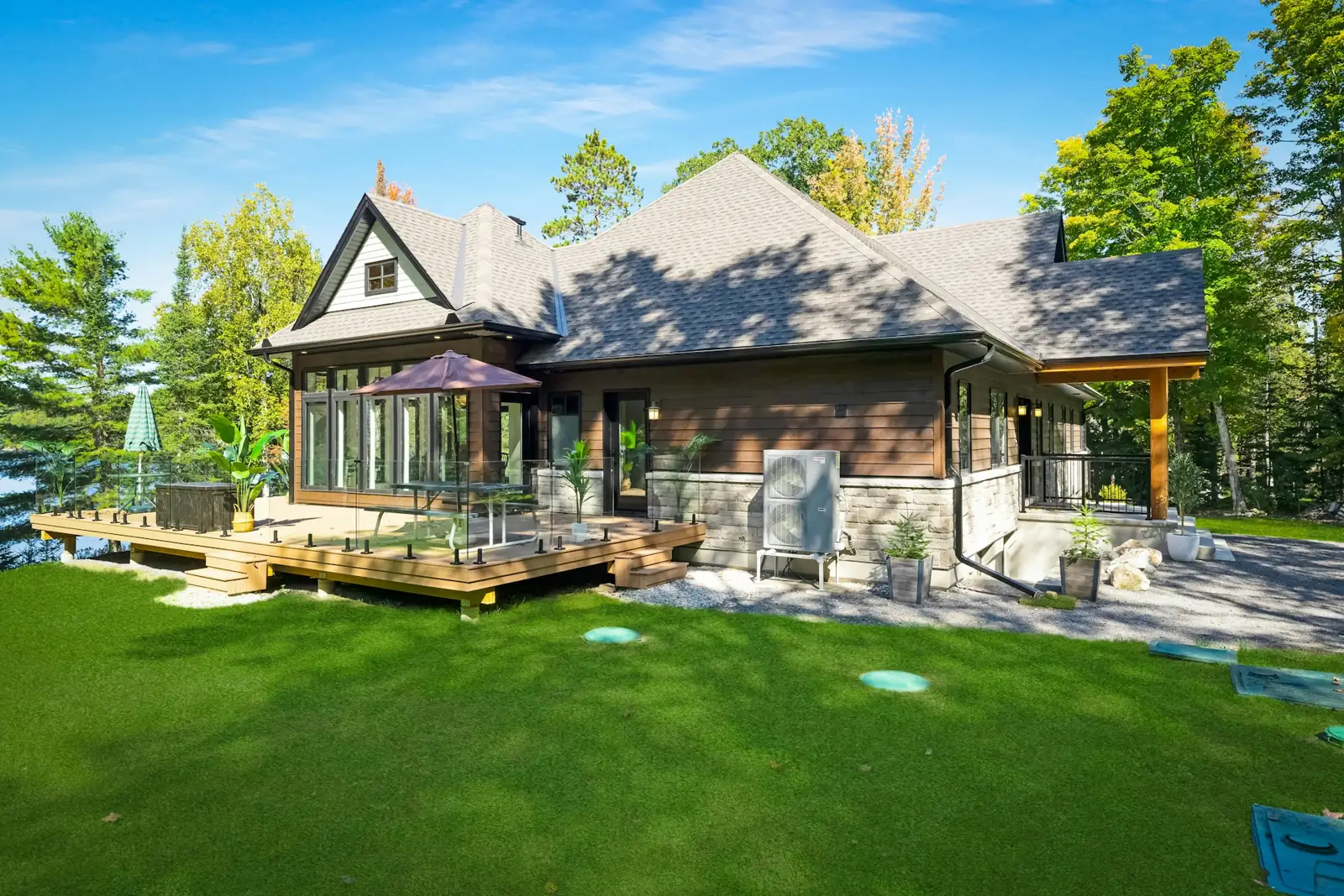
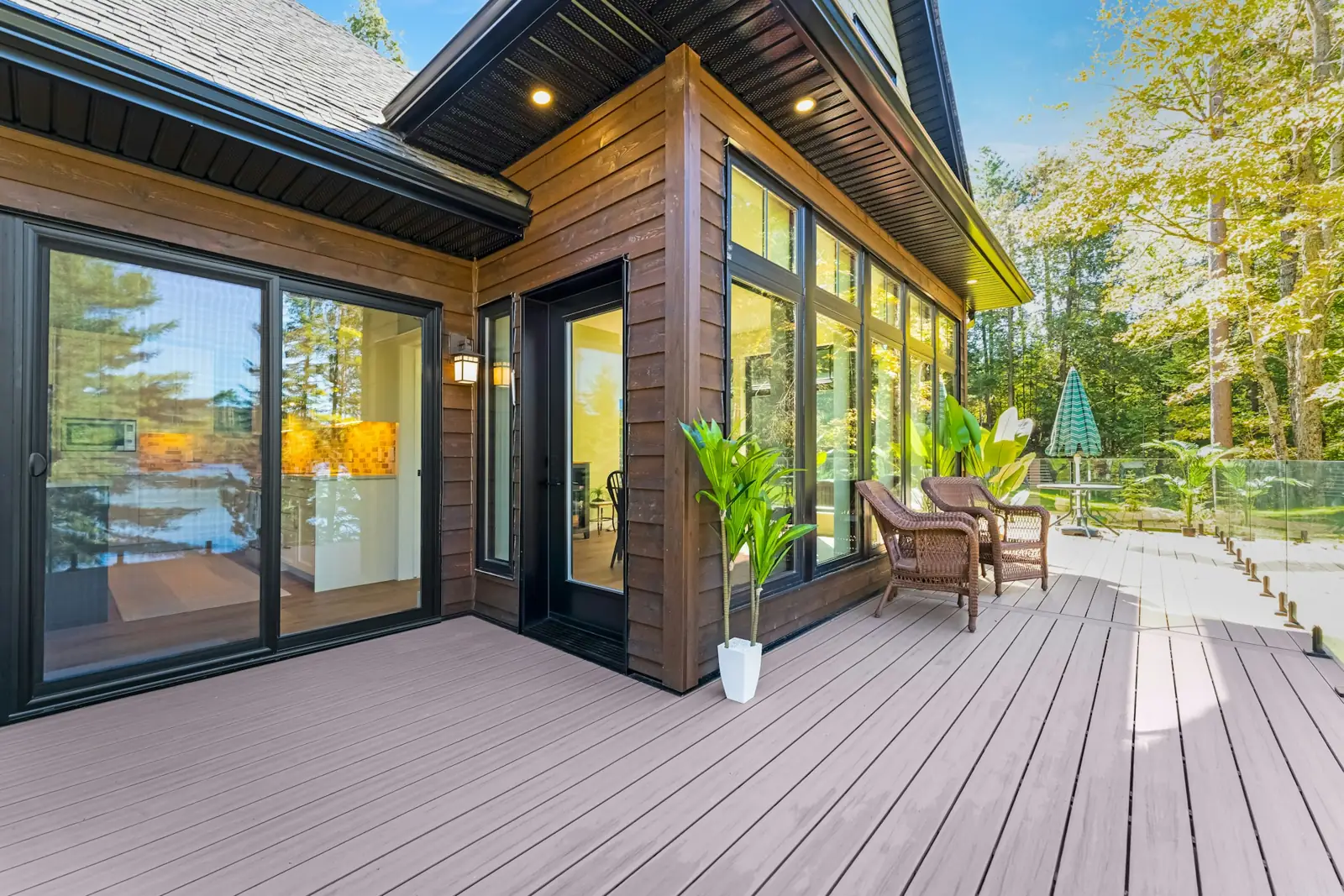
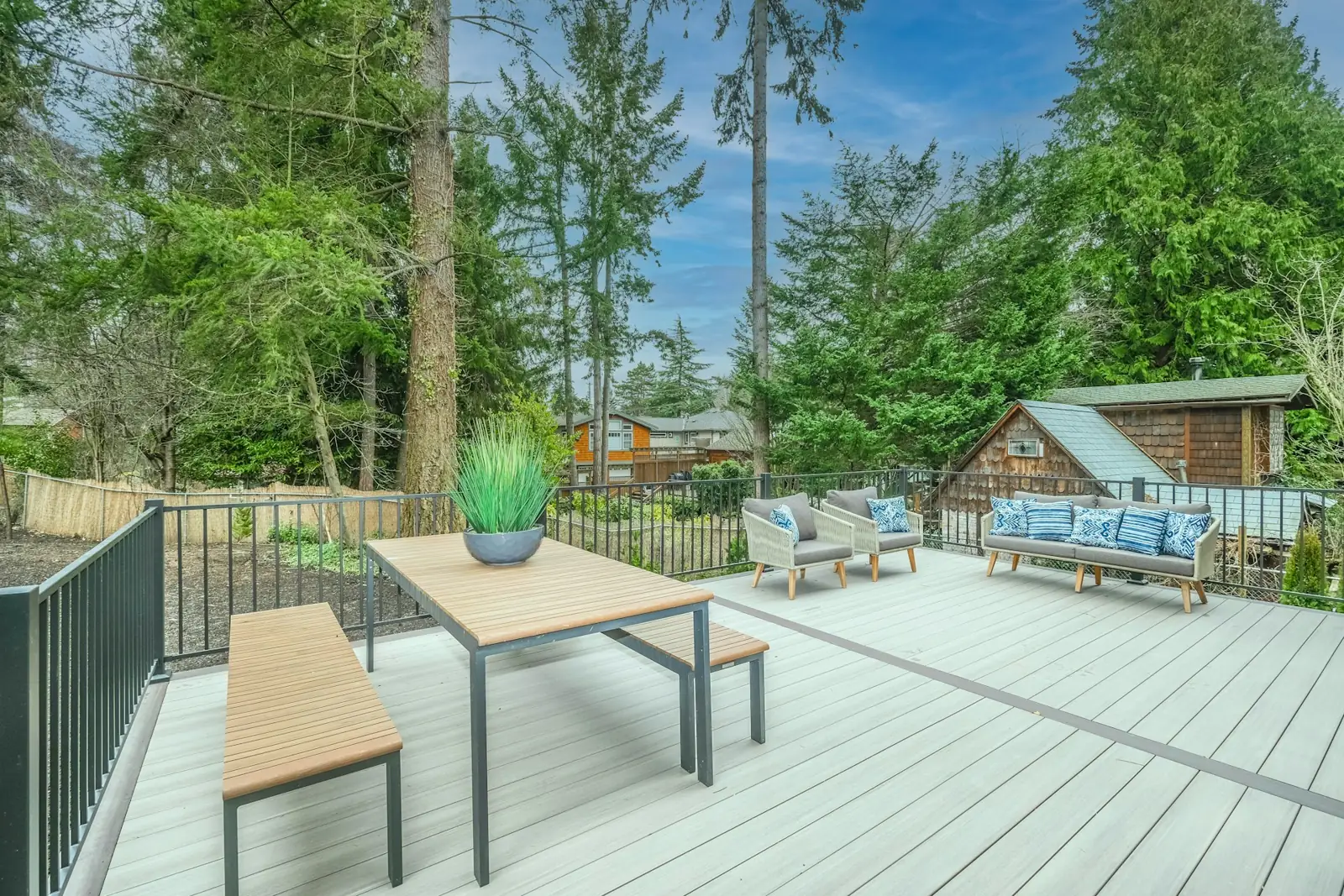
Composite and PVC decking do not need staining, do not splinter, and resist rot, which is why they have become the default for new decks in Maine. Composite boards blend wood fiber and plastic under a protective cap; PVC boards are all synthetic and lighter. The North Deering farmhouse on this site got a rebuilt deck with AZEK composite decking. The framing underneath is still wood, so it is built to last as long as the boards on top.
- Layout, size and board color are chosen with the owner at the estimate visit.
- Footings and framing are built to code, with joist spacing that suits the board manufacturer's span rules.
- Joist tape or flashing protects the tops of joists and the ledger.
- Boards go down with hidden fasteners or color-matched screws and the expansion gaps the product requires.
- Matching railings, stair treads, fascia and landings finish the deck.
Signs it is time
- You are done staining and sealing a wood deck every year or two
- The deck is in shade or near water where wood stays damp
- You want a deck that stays barefoot-friendly with no splinters
What affects the price of composite and PVC decks
- Composite versus PVC, and the product line
- Deck size, height and shape
- Railing system and stairs
- Hidden-fastener versus face-screw installation
- Footing and framing conditions
Every job is priced from a free on-site visit. Typical ranges for the trade are on our deck building page, and the details of this service are on the composite and PVC decks overview.
For a deeper walkthrough of materials, code details and photos, see our full Composite & PVC Decks: What Changes From Pressure-Treated Lumber guide.
More in Saco and nearby
Back to the Saco exterior services overview, or see every town on our service areas page.
Other exterior work in Saco
- Deck Replacement in Saco
- Siding Replacement in Saco
- Vinyl Siding Installation in Saco
- James Hardie Fiber Cement Siding in Saco
- Cedar Siding & Shingles in Saco
- Window Replacement in Saco
- Bay & Picture Windows in Saco
- Roof Replacement in Saco
- Asphalt Shingle Roofing in Saco
- Metal Roofing in Saco
- Deck Building in Saco
Get a free composite and PVC decks estimate in Saco
Tell us about the house and what you want changed. One of the owners will call to set up a visit, measure, and write a fixed-price proposal. No pressure, no obligation.
Need it today?Call Mike (207) 408-5388
or Bob at (207) 252-0759
More ways we can help
Google reviewsServices
16Homeowners often pair this with our other work, including…
Service Areas
38We also serve homeowners in…