
Composite & PVC Decks in South Portland, Maine
Composite & PVC Decks for South Portland homes from a family-owned Portland company. An owner measures on site and writes a fixed-price proposal.
- 5.0 · 8 Google reviews
- Fully licensed & insured
- Free estimates
- 20+ years combined experience
Composite & PVC Decks for South Portland homes
Composite and PVC decking suits the salt air and freeze-thaw cycles common across South Portland. Near Willard Beach and Spring Point, salt spray and sun break down stained wood surfaces within a few seasons, while capped composite boards resist fading, splintering and moisture. Inland, on lots shaded by trees, a capped board resists the mildew and rot that attack wood in damp shade.
The board is only part of the system. Framing under a composite deck is usually pressure-treated lumber and has to meet the same code, footing and ledger requirements as any deck, and the framing spacing must match the board maker's rules. Composite expands and contracts with temperature, so gaps at the ends and edges must allow for the swing from a hot August afternoon to a January night. Darker boards get hot in full sun, which matters on a south-facing deck used barefoot in summer. Railings in composite, aluminum or cable can keep a harbor view open while meeting guard height requirements. For owners who would rather spend weekends at the beach than staining boards, low upkeep is the main reason to choose composite.
South Portland housing at a glance
South Portland has about 12,800 housing units, and the American Community Survey estimates a median year built of 1968, two decades newer than Portland across the harbor. About 25 percent of homes predate 1940 and about 45 percent predate 1960. Roughly 16 percent went up between 1960 and 1979, and close to 19 percent date from 2000 or later, a larger share of newer construction than on the peninsula. Owners occupy about 58 percent of occupied homes, and single-family detached houses make up a little over half the stock, with apartments, condominiums and two-family houses filling out the rest. Seasonal homes are rare, only about 100 units. The older waterfront villages hold the city's early wood-frame houses, while the neighborhoods farther inland are largely post-war and later.
Permits and design review in South Portland
Building permits in South Portland come from Code Enforcement, part of the Department of Planning and Development, which issues permits and conducts inspections for building, electrical and plumbing work. Applications can go through the city's online portal or by email. The city enforces the Maine Uniform Building and Energy Code, based on the 2021 International Residential Code, and a permitted project must make a substantial start within 180 days. Since 2019, a building permit for exterior work on a designated historic property or any structure built in 1940 or earlier may be delayed up to 90 days. Shoreland zoning applies along the harbor and bay.
Weather and exposure in South Portland
South Portland faces Portland Harbor and the Fore River on its north side and Casco Bay to the east, so houses in Ferry Village, Willard and the streets near Spring Point take salt air and onshore wind, while western neighborhoods near the Maine Mall are more sheltered. The city shares its weather with the Portland International Jetport, whose main runway lies inside South Portland, and the Portland area averages about 69 inches of snow a year, with some winters far lighter or heavier. Nor'easters drive rain and snow sideways against exposed walls, and repeated freeze and thaw loosens caulk, paint and shingles. Near the water, salt speeds corrosion of flashing and fasteners.
What composite and PVC decks involves
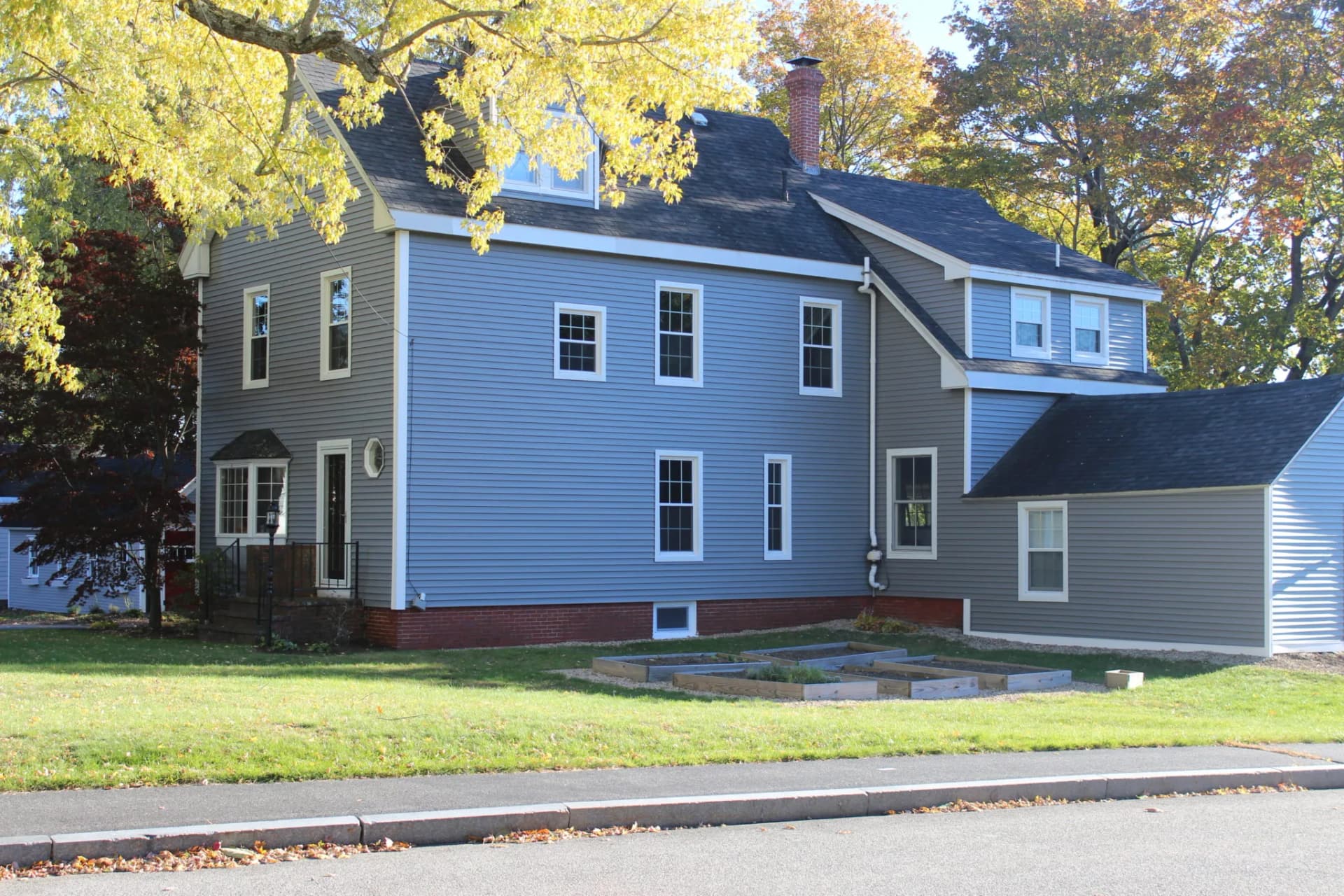
Composite and PVC decking do not need staining, do not splinter, and resist rot, which is why they have become the default for new decks in Maine. Composite boards blend wood fiber and plastic under a protective cap; PVC boards are all synthetic and lighter. The North Deering farmhouse on this site got a rebuilt deck with AZEK composite decking. The framing underneath is still wood, so it is built to last as long as the boards on top.
- Layout, size and board color are chosen with the owner at the estimate visit.
- Footings and framing are built to code, with joist spacing that suits the board manufacturer's span rules.
- Joist tape or flashing protects the tops of joists and the ledger.
- Boards go down with hidden fasteners or color-matched screws and the expansion gaps the product requires.
- Matching railings, stair treads, fascia and landings finish the deck.
Signs it is time
- You are done staining and sealing a wood deck every year or two
- The deck is in shade or near water where wood stays damp
- You want a deck that stays barefoot-friendly with no splinters
What affects the price of composite and PVC decks
- Composite versus PVC, and the product line
- Deck size, height and shape
- Railing system and stairs
- Hidden-fastener versus face-screw installation
- Footing and framing conditions
Every job is priced from a free on-site visit. Typical ranges for the trade are on our deck building page, and the details of this service are on the composite and PVC decks overview.
More in South Portland and nearby
Back to the South Portland exterior services overview, or see every town on our Cumberland County service areas page.
Other exterior work in South Portland
- Deck Replacement in South Portland
- Siding Replacement in South Portland
- Vinyl Siding Installation in South Portland
- James Hardie Fiber Cement Siding in South Portland
- Cedar Siding & Shingles in South Portland
- Window Replacement in South Portland
- Bay & Picture Windows in South Portland
- Roof Replacement in South Portland
- Asphalt Shingle Roofing in South Portland
- Metal Roofing in South Portland
- Deck Building in South Portland
Get a free composite and PVC decks estimate in South Portland
Tell us about the house and what you want changed. One of the owners will call to set up a visit, measure, and write a fixed-price proposal. No pressure, no obligation.
Need it today?Call Mike (207) 408-5388
or Bob at (207) 252-0759