

Cedar Siding & Shingles in Casco, Maine
Cedar Siding & Shingles for Casco homes from a family-owned Portland company. An owner measures on site and writes a fixed-price proposal.
- Google reviews
- Fully licensed & insured
- Free estimates
- 20+ years combined experience
Cedar Siding & Shingles for Casco homes
Cedar shingles and boards have been on Casco's lake cottages for generations, and for many owners a camp on Pleasant Lake or Thomas Pond does not look right in anything else. New cedar keeps that character, and it can be left to silver naturally in the lake air or ordered with a factory-applied finish. On older buildings, narrow clapboard like that on the Friends Meetinghouse is the traditional profile, and cedar clapboard can match it for a restoration-minded owner.
The tradeoff is care. Under tall pines, cedar stays damp and can grow mildew and moss, so a rainscreen gap behind the shingles and good clearance above the ground and snow line extend its life. On the Sebago shore, sun and wind weather cedar faster. Cardinal installs new cedar siding as part of a full siding job and does not provide staining or spot repairs, so owners should plan for that upkeep themselves. For a seasonal cottage that sits closed up for months, the choice between cedar's look and a lower-maintenance material deserves a real conversation during the on-site estimate.
How a Siding Wall Assembly Works
- Sheathing — the structural wall surface everything else attaches to
- Weather-resistive barrier — a wrapped membrane that stops bulk water while letting vapor escape
- Rainscreen gap — a drainage and drying space between the barrier and the siding
- Siding — the visible cladding, fastened over the furring strips
- Window flashing — tucked under the barrier above and lapped over the siding below, so water never gets behind it
Casco housing at a glance
Census estimates count about 2,970 housing units in Casco, with a median year built of 1988, noticeably newer than Raymond's 1976. Only about 5 percent predate 1940 and around 18 percent predate 1960, while roughly 31 percent have gone up since 2000. About 76 percent are single-family detached homes, a lower share than in neighboring Raymond, and about 90 percent of occupied homes are owned by the people living in them. Seasonal use is large: roughly 1,210 units, about four in ten, are held for seasonal or recreational occupancy, from shoreline cottages to second homes. The town also runs a short-term rental registration ordinance, since many lake houses are rented by the week. The older layer is small but real, including a Federal-style house from about 1795 in South Casco.
Weather and exposure in Casco
Casco is inland, so the weather that wears on houses here is snow, cold and the wind off big water, not salt. Published normals from the National Weather Service office in nearby Gray show about 84 inches of snow a year for 1991-2020, well above the roughly 69 inches at the Portland Jetport. Deep cold and midwinter thaws alternate from December into March. Cottages on the north shore of Sebago Lake face miles of open water to the south, and Sebago rarely freezes over completely, so that exposure lasts through the winter. Houses on Pleasant Lake, Thomas Pond and the smaller ponds sit among tall pines, where shade and needle litter keep roofs and decks damp.
Permits and design review in Casco
Casco's Code Enforcement Department, which the town calls its building department, works from the town office at 635 Meadow Road and meets by appointment. Since April 7, 2025 the town enforces the 2021 I-codes under Maine's uniform building code. The building permit application asks whether a lot is in shoreland, water body, wetland or resource protection zoning, wants a plot plan with roadside and lakeside setbacks, and records lot coverage. Permits are valid for one year. Work in the shoreland zone, within 250 feet of a great pond, uses a separate Shoreland Project Permit Application with photos before and after construction.
Casco at a Glance
What the housing stock and local code enforcement mean for a siding, window, roofing or deck job here.
3,696
Population (ACS estimate)
Median year built: 1988
Mostly vinyl or fiber-cement siding and insulated replacement windows from recent decades.
State Building & Energy Code (MUBEC)
Local option — population under 4,000
EPA Lead-Safe Rule (pre-1978 homes)
Applies to at least 18% of homes here
Shoreland Zoning
Applies near the water
Permits
Casco Code Enforcement Office
Codes & Permits for Cedar Siding in Casco
In Casco, exterior-work permits come from the Casco Code Enforcement Office (635 Meadow Road, Casco, ME 04015, 207-627-4515, ext. 1203). Casco sits at or under the 4,000-resident line where MUBEC enforcement is a local option rather than a state mandate.
- Maine's adopted 2021 IRC (R703.5) covers wood siding: a water-resistive barrier is required per R703.2, fasteners must penetrate a minimum of 1.5 inches into studs or blocking (R703.3.4), and horizontal lap siding needs a minimum 1-inch overlap (0.5 inch if rabbeted) per R703.5.3. up.codes
- Beyond the code minimums, a vented rainscreen gap behind wood/cedar siding is common installation practice in Maine's cold, wet coastal climate to let cladding dry and reduce moisture-driven rot — this is standard trade practice referenced in building-science guidance, not itself a numbered MUBEC/IRC mandate, so it should be described to clients as a recommended practice rather than a code requirement. up.codes
- Maine's Shoreland Zoning Act creates a regulated shoreland zone extending 250 feet (horizontal distance) from the normal high-water line of any great pond, river, or coastal wetland, and 75 feet from certain streams; the Act's stated purposes include protecting buildings and land from flooding/erosion and controlling water pollution, and it governs deck and other structure setbacks and the expansion of nonconforming structures within that zone (specific setback/expansion rules are set at the municipal-ordinance level under the state's model guidelines). maine.gov
- By Maine law (25 M.R.S. §2373), 'the code must be enforced in a municipality that has more than 4,000 residents' (per the most recent federal census); municipalities at or below that population are not required to adopt/enforce MUBEC but may opt in locally, per the state's own program page: 'All municipalities with a population greater than 4,000 are required, by statute, to enforce the MUBEC. Municipalities with a population under 4,000 may choose to enforce the MUBEC.' mainelegislature.org
How Cardinal Exteriors Handles Cedar Siding in Casco
- With 3,696 residents, Casco falls below the threshold for mandatory statewide code enforcement, but that doesn't change the permit and inspection Cardinal builds to on every job here.
- At least 18% of Casco's homes predate 1960 — well ahead of 1978, when the EPA's lead-safe renovation rule kicks in — so we plan for lead-safe work practices on cedar siding and shingles whenever painted surfaces come off an older house here.
- Casco's shoreline, lake or river frontage falls under Maine's Mandatory Shoreland Zoning Act, so we check setback rules before work starts near the water.
- We file for cedar siding and shingles permits at the Casco Code Enforcement Office before work starts, not after.
The entrance to the Point Sebago Resort area on Point Sebago Road in Casco, near Sebago Lake.
Street View © Google
What cedar siding and shingles involves
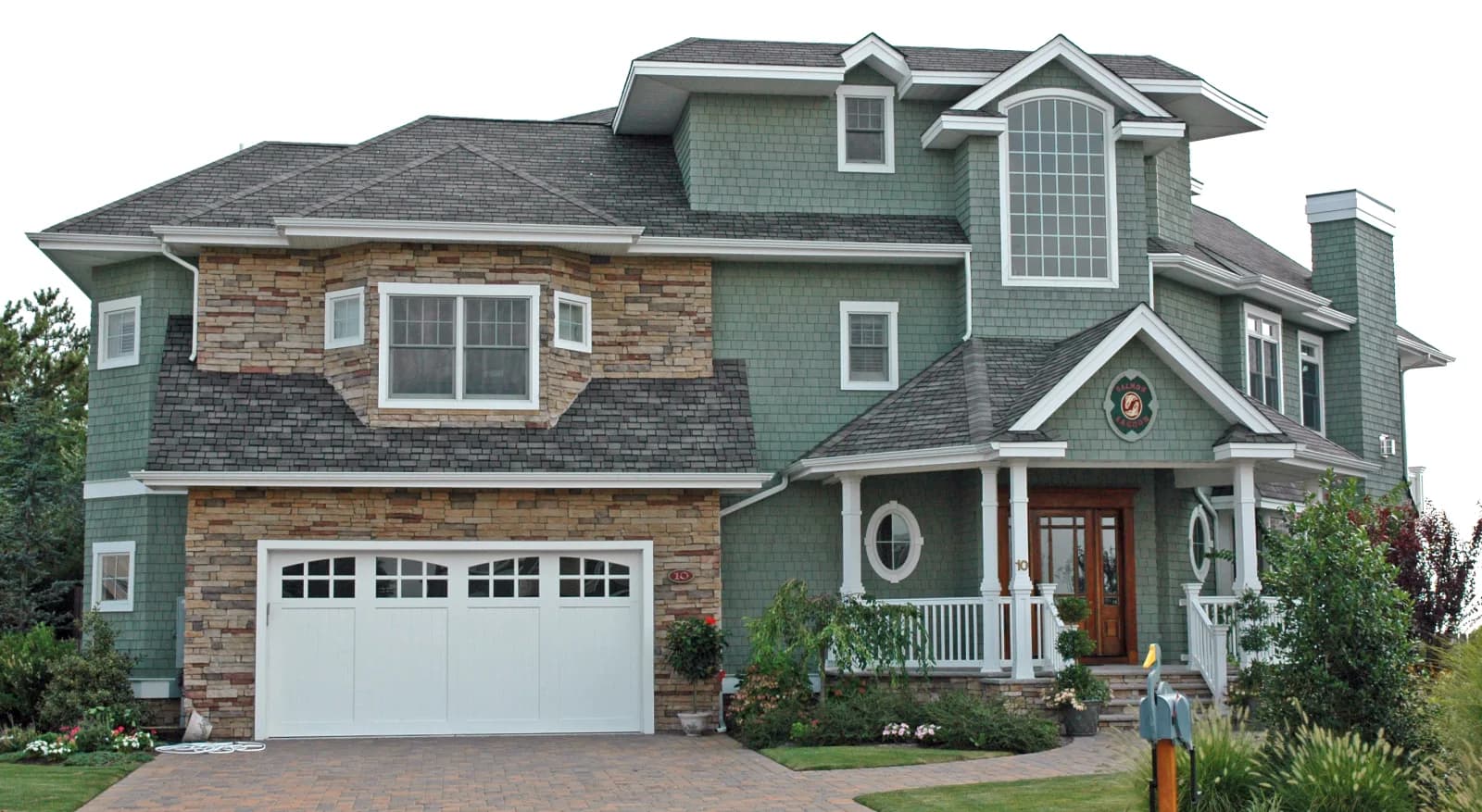
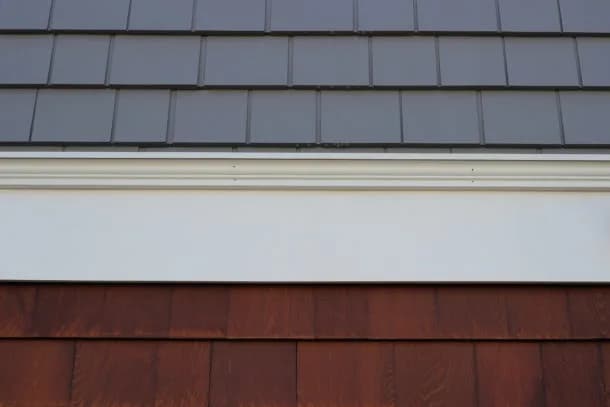
Cedar clapboards and shingles are the original New England exterior, and for shingle-style cottages, capes and historic homes nothing else looks quite right. Cedar is naturally rot-resistant and light, but it is wood: it needs airflow behind it and a finish that suits the exposure. Pre-finished shingles, such as the Maibec shingles on several projects shown on this site, arrive stained or primed on all sides, which cuts the upkeep and evens out the color.
- Walls are stripped, repaired and wrapped; where it helps drying, a ventilated or drainage layer goes behind the cedar.
- Shingles are coursed and laid out so exposure lines up at windows, doors and corners.
- Stainless or hot-dipped galvanized fasteners are used so they do not stain or corrode.
- Corners are woven or finished with boards, and trim is detailed to shed water.
- Pre-finished product is touched up at cuts; natural cedar is left to weather or finished as you choose.
Signs it is time
- The house is a cape, shingle-style cottage or historic home where cedar belongs
- Existing shingles are cupped, split, missing or black with mildew
- A historic district or your own taste calls for real wood
- You want a natural finish that weathers to silver-gray
What affects the price of cedar siding and shingles
- Clapboard versus shingle, and grade of cedar
- Pre-finished versus natural or site-finished
- Coursing detail, corner treatment and trim
- Wall area, height and tear-off
- Any rainscreen or drainage layer behind the siding
Every job is priced from a free on-site visit. Typical ranges for the trade are on our siding page, and the details of this service are on the cedar siding and shingles overview.
For a deeper walkthrough of materials, code details and photos, see our full Cedar Siding & Shingles: A Traditional Maine Look That Needs the Right Prep Underneath guide.
More in Casco and nearby
Back to the Casco exterior services overview, or see every town on our service areas page.
Other exterior work in Casco
- Window Replacement in Casco
- Bay & Picture Windows in Casco
- Roof Replacement in Casco
- Asphalt Shingle Roofing in Casco
- Metal Roofing in Casco
- Deck Building in Casco
- Composite & PVC Decks in Casco
- Deck Replacement in Casco
- Siding Replacement in Casco
- Vinyl Siding Installation in Casco
- James Hardie Fiber Cement Siding in Casco
Get a free cedar siding and shingles estimate in Casco
Tell us about the house and what you want changed. One of the owners will call to set up a visit, measure, and write a fixed-price proposal. No pressure, no obligation.
Need it today?Call Mike (207) 408-5388
or Bob at (207) 252-0759
More ways we can help
Google reviewsServices
16We provide complete siding, window, roofing and deck work, including…
Service Areas
38Our service area reaches across Greater Portland, from…