


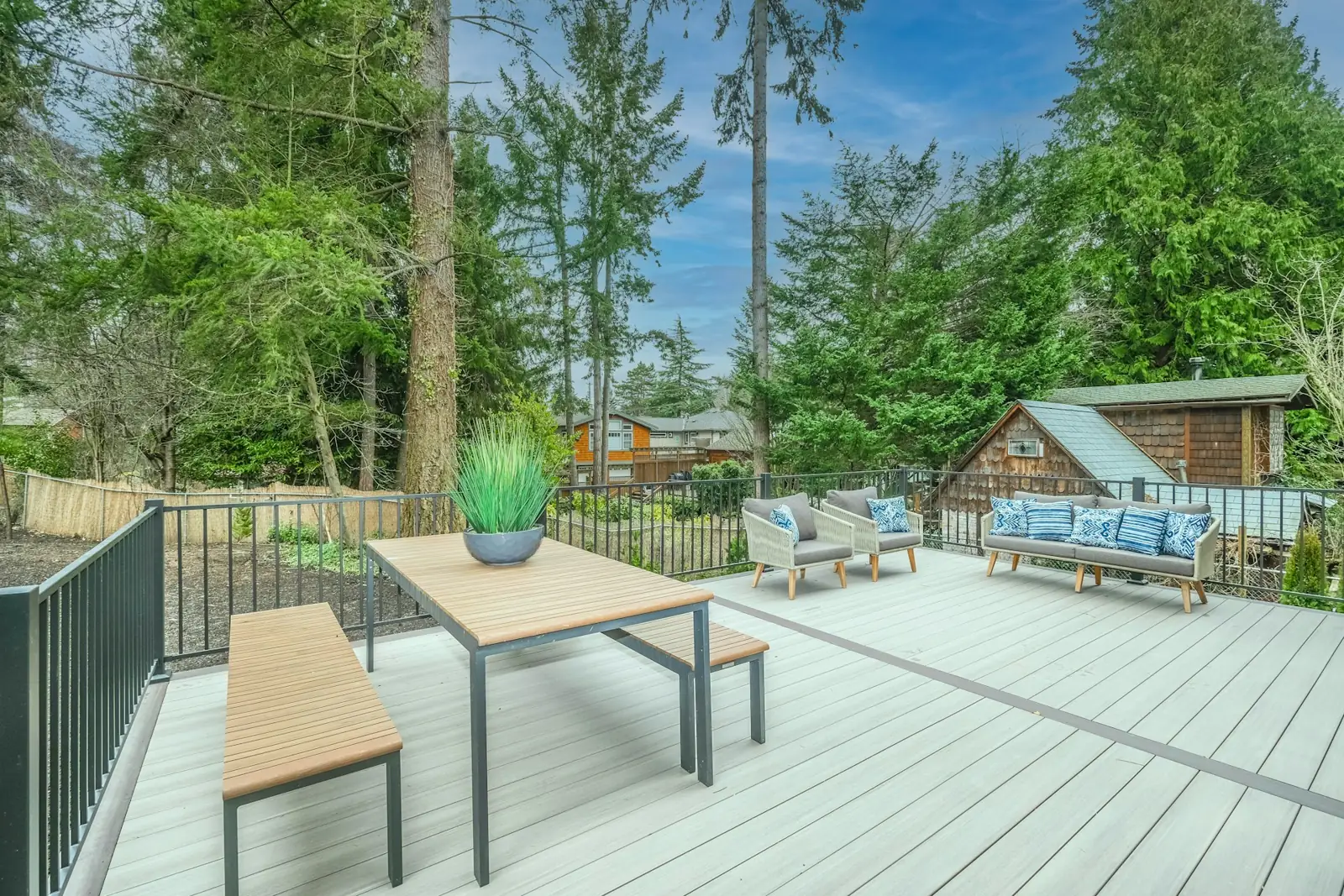
Composite & PVC Decks in New Gloucester, Maine
Composite & PVC Decks for New Gloucester homes from a family-owned Portland company. An owner measures on site and writes a fixed-price proposal.
- Google reviews
- Fully licensed & insured
- Free estimates
- 20+ years combined experience
Composite & PVC Decks for New Gloucester homes
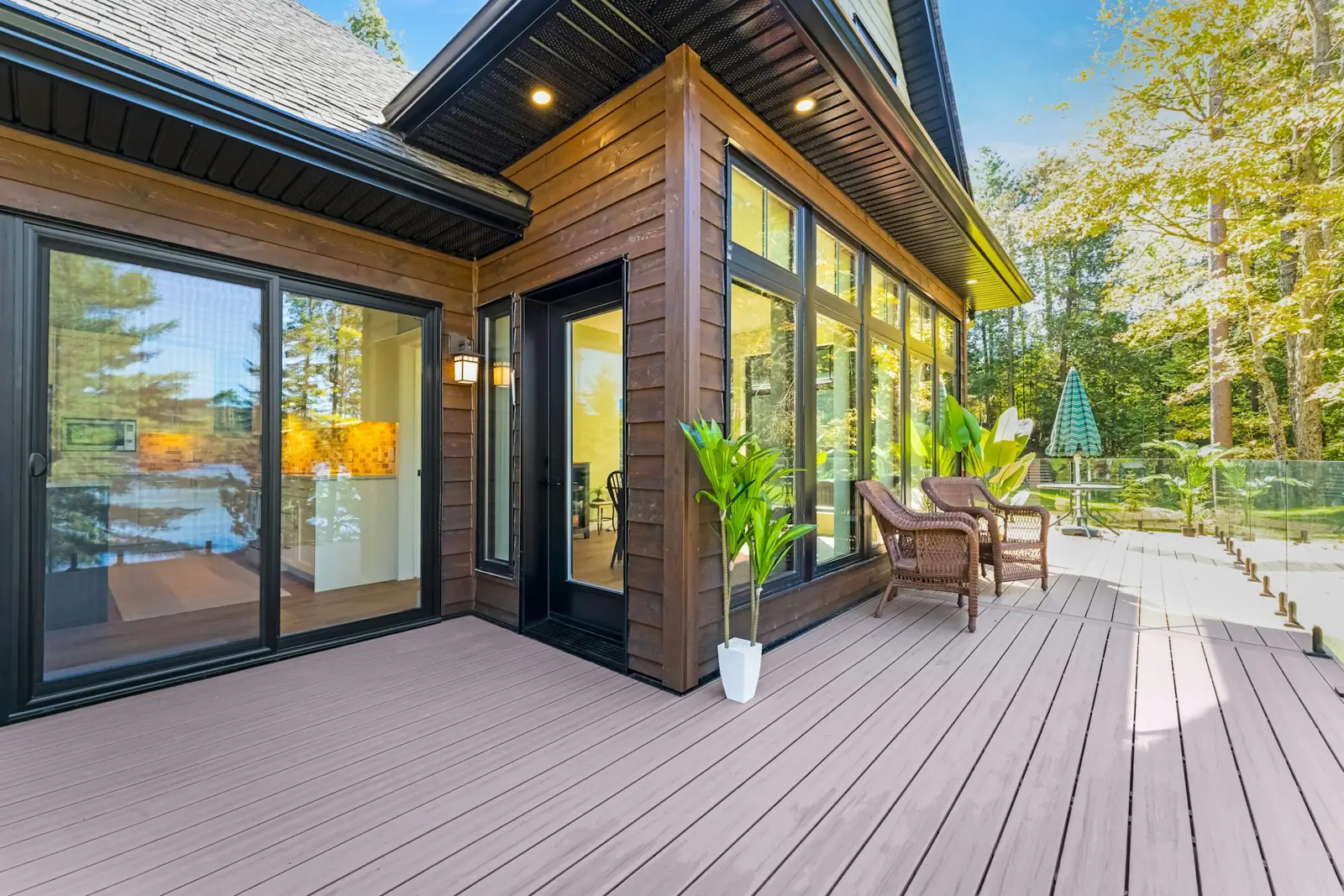
Composite and PVC boards suit the way most New Gloucester families use a deck: a year-round home, often on a newer lot, where nobody wants to stain boards every other summer. Capped composite resists the mildew that forms on wood decking near woods and damp fields, and cellular PVC boards take on almost no water, which helps through months of freezing and thawing. Both come in wood-toned colors that sit comfortably next to a farmhouse ell.
Winter use sets a few rules. Composite moves with temperature, so board gaps and fastener spacing follow the manufacturer's instructions for cold-weather installs, and joist spacing is often tighter than a wood deck needs. The frame underneath is still pressure-treated lumber, and it has to meet the same 48-inch sonotube footing and 36-inch guard requirements the town lists for any deck. Before shoveling or spreading ice melt, check what the board maker allows so the surface and the warranty stay intact. Boards laid over a well-flashed ledger and properly spaced joists will stay flat and quiet for a long time.
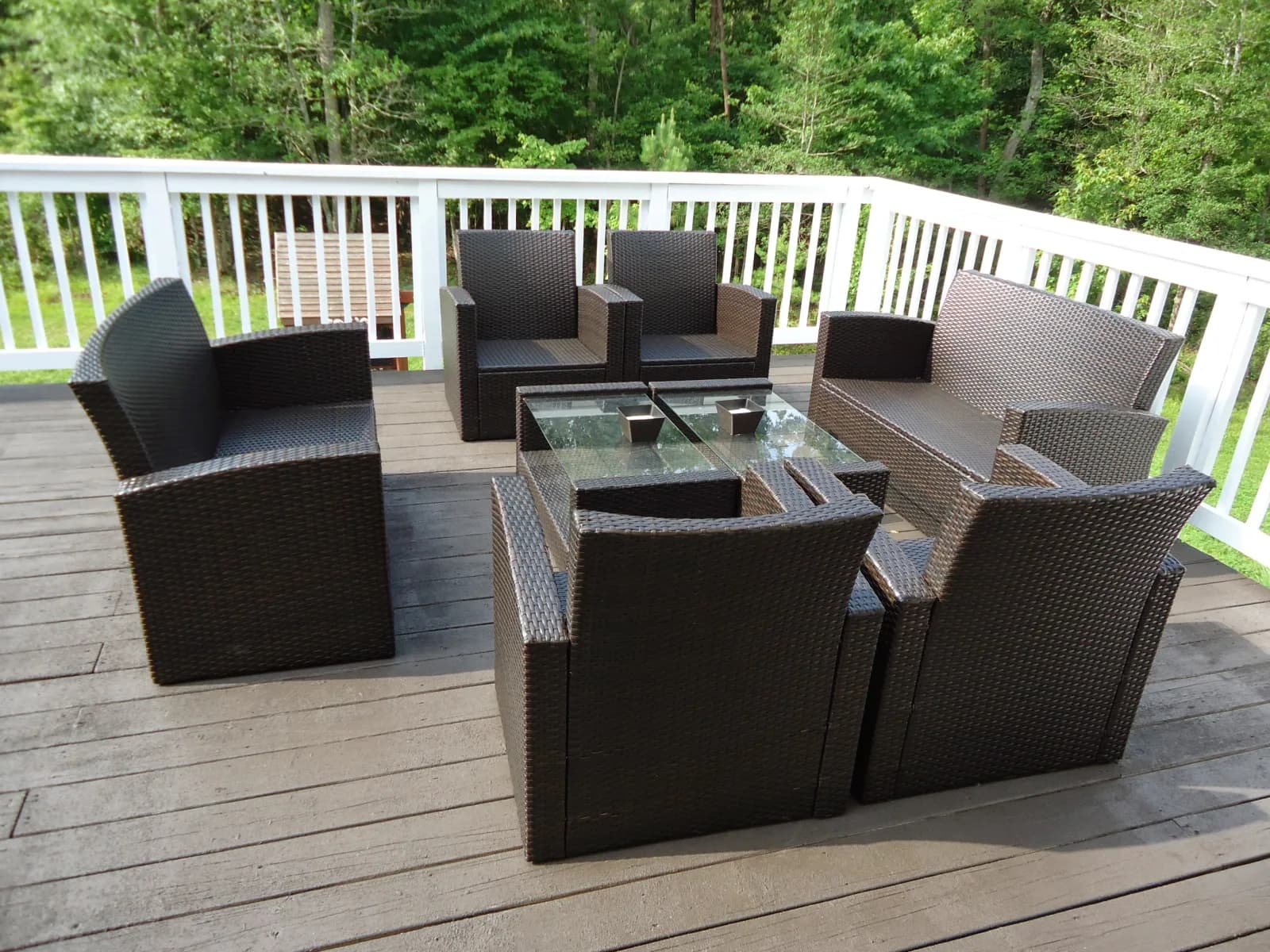
How a Deck Structure Is Built
- Footing — poured below Maine’s frost line so winter heaving cannot move it
- Post — carries the beam load down to the footing
- Beam — spans between posts and carries the outer ends of the joists
- Ledger — bolted to the house framing, with flashing that diverts water away from the wall
- Joists — span from the ledger to the beam, sized and spaced to the decking and the load
- Decking — the walking surface, fastened on top with spacing for drainage
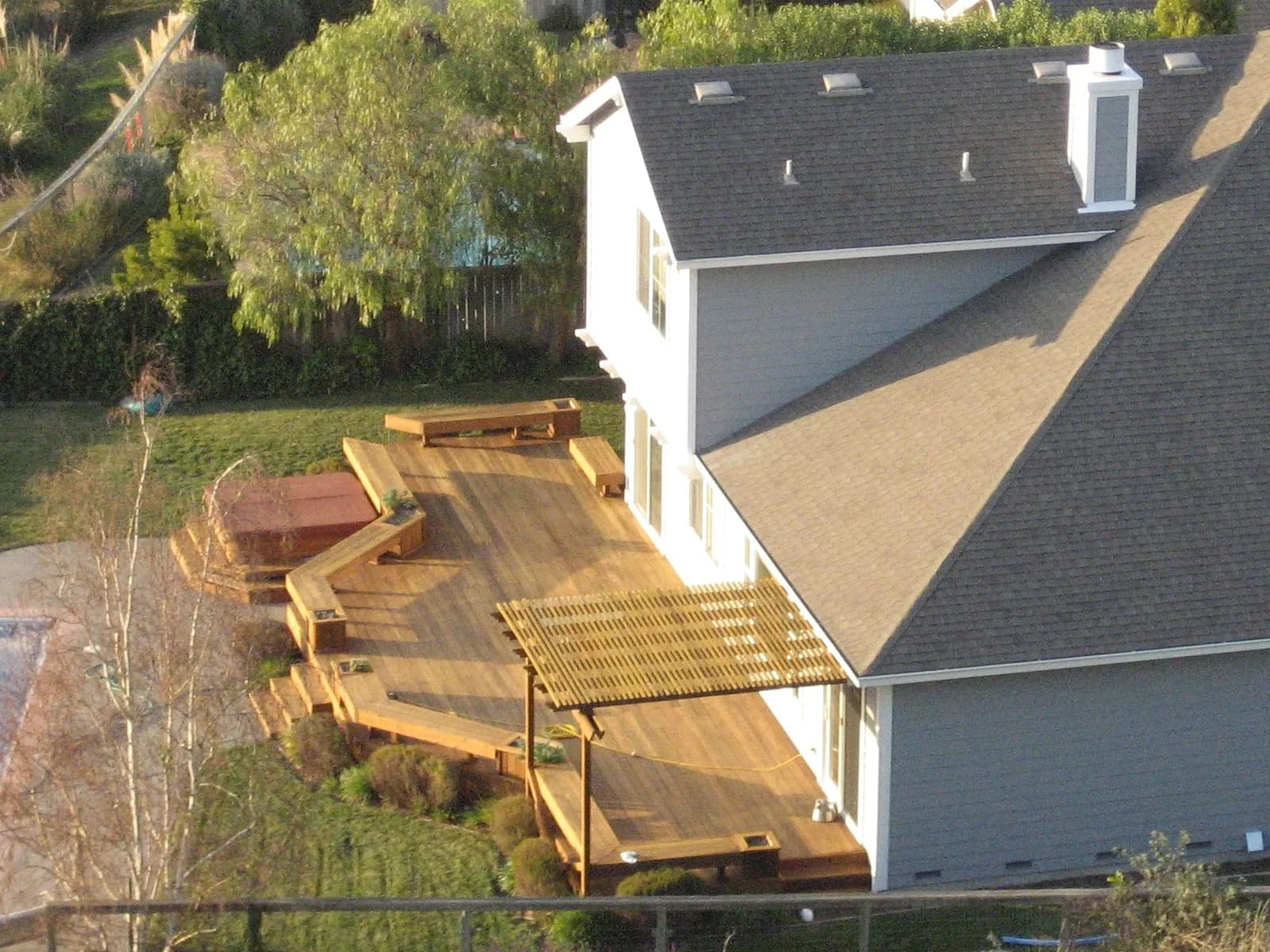
New Gloucester housing at a glance
Census estimates put New Gloucester at about 2,260 housing units with a median year built of 1991. About 11 percent of homes predate 1940 and roughly one in five predates 1960, but the largest share, about 31 percent, has been built in 2000 or later. Only about 15 percent date from 1960 to 1979, a much thinner mid-century layer than in neighboring Gray. Around 70 percent of units are single-family detached houses, and about 83 percent of occupied homes are owner-occupied. Seasonal homes are rare, about two dozen by the survey's count, so nearly every house here is lived in year-round. The oldest houses are notable: the village holds many wood-frame houses built before 1810 in Georgian and Federal styles, and Intervale Farm's circa-1811 brick farmhouse is joined to its barn by a string of wood-frame additions.
Permits and design review in New Gloucester
New Gloucester's Code Enforcement Officer, who also serves as plumbing inspector and health officer, issues building permits. Under Article 6.1.1 of the zoning ordinance, no structure may be erected, moved, added to or structurally altered without one. The office's handout says regular maintenance such as roofing, siding and window replacement needs no permit when it does not alter the structure. Decks do: the permit checklist asks for a foundation plan, framing cross sections and a signed plot plan with setbacks. The town's FAQ notes that work within 100 feet of a water body may need Maine DEP approval.
Weather and exposure in New Gloucester
New Gloucester is inland farm country, with the town center at roughly 364 feet and no salt exposure. The nearest long-term record is next door: NOAA's 1991-2020 normals for the Gray station list about 84 inches of snow a year, and January there averages near 22 degrees. The town's own code enforcement handout gives the figures it builds to, a total snow load of 70 pounds per square foot and a 100 mph wind speed. Open fields along the Intervale and around the farms let wind drive snow and rain against the long walls of connected farmhouses, and repeated freeze-thaw cycles work into any joint that holds water.
New Gloucester at a Glance
What the housing stock and local code enforcement mean for a siding, window, roofing or deck job here.
5,676
Population (ACS estimate)
Median year built: 1991
Mostly vinyl or fiber-cement siding and insulated replacement windows from recent decades.
State Building & Energy Code (MUBEC)
Enforced — population over 4,000
EPA Lead-Safe Rule (pre-1978 homes)
Applies to at least 21% of homes here
Historic District
Exterior work may need design review
Shoreland Zoning
Applies near the water
Permits
New Gloucester Code Enforcement Office
Codes & Permits for Composite Decks in New Gloucester
In New Gloucester, exterior-work permits come from the New Gloucester Code Enforcement Office (385 Intervale Road, New Gloucester, ME 04260, (207) 926-4126 x3). With 5,676 residents, over 4,000, New Gloucester is required to enforce the Maine Uniform Building and Energy Code (MUBEC). The New Gloucester Historic District covers the Georgian and Federal-era houses of the old village and Shaker Village.
- Maine's adopted 2021 IRC (R507.2.2) requires plastic composite deck boards, stair treads, guards, and handrails to comply with ASTM D7032, and (R507.2.2.1) to be labeled with the allowable load and maximum allowable span determined under ASTM D7032 — meaning composite span limits come from the product's own ASTM D7032 listing/manufacturer data rather than the standard wood joist-span tables, and are often shorter, requiring closer joist spacing than an equivalent wood board. up.codes
- Composite decking installation must follow both the code and the manufacturer's instructions (R507.2.2.5), so a given product's specific fastening pattern and joist spacing should be pulled from its ICC-ES evaluation report or manufacturer install guide, not assumed from a generic wood-deck spec. up.codes
- Maine's Shoreland Zoning Act creates a regulated shoreland zone extending 250 feet (horizontal distance) from the normal high-water line of any great pond, river, or coastal wetland, and 75 feet from certain streams; the Act's stated purposes include protecting buildings and land from flooding/erosion and controlling water pollution, and it governs deck and other structure setbacks and the expansion of nonconforming structures within that zone (specific setback/expansion rules are set at the municipal-ordinance level under the state's model guidelines). maine.gov
- By Maine law (25 M.R.S. §2373), 'the code must be enforced in a municipality that has more than 4,000 residents' (per the most recent federal census); municipalities at or below that population are not required to adopt/enforce MUBEC but may opt in locally, per the state's own program page: 'All municipalities with a population greater than 4,000 are required, by statute, to enforce the MUBEC. Municipalities with a population under 4,000 may choose to enforce the MUBEC.' mainelegislature.org
How Cardinal Exteriors Handles Composite Decks in New Gloucester
- Every ledger we attach for a composite and PVC decks job in New Gloucester is flashed to Maine's adopted deck code, with corrosion-resistant metal or an approved nonmetallic alternative, not a bare lag bolt into siding.
- Footings on a composite and PVC decks job in New Gloucester are sized to the load and set below the local frost line, per Maine's adopted residential code, not a guess at depth.
- Because New Gloucester has coastal, lake or river frontage, Maine's Mandatory Shoreland Zoning Act may apply to work close to the water, which can affect setbacks on a rebuild.
- New Gloucester's population (5,676) puts it above the threshold where Maine law requires full MUBEC enforcement, so this job is inspected against that code as well as the local permit.
- Anything that needs a permit for composite and PVC decks goes through the New Gloucester Code Enforcement Office.
A rural stretch of Town Farm Road in New Gloucester, between Pineland Farms and Sabbathday Lake Shaker Village.
Street View © Google
What composite and PVC decks involves
Composite and PVC decking do not need staining, do not splinter, and resist rot, which is why they have become the default for new decks in Maine. Composite boards blend wood fiber and plastic under a protective cap; PVC boards are all synthetic and lighter. The North Deering farmhouse on this site got a rebuilt deck with AZEK composite decking. The framing underneath is still wood, so it is built to last as long as the boards on top.
- Layout, size and board color are chosen with the owner at the estimate visit.
- Footings and framing are built to code, with joist spacing that suits the board manufacturer's span rules.
- Joist tape or flashing protects the tops of joists and the ledger.
- Boards go down with hidden fasteners or color-matched screws and the expansion gaps the product requires.
- Matching railings, stair treads, fascia and landings finish the deck.
Signs it is time
- You are done staining and sealing a wood deck every year or two
- The deck is in shade or near water where wood stays damp
- You want a deck that stays barefoot-friendly with no splinters
What affects the price of composite and PVC decks
- Composite versus PVC, and the product line
- Deck size, height and shape
- Railing system and stairs
- Hidden-fastener versus face-screw installation
- Footing and framing conditions
Every job is priced from a free on-site visit. Typical ranges for the trade are on our deck building page, and the details of this service are on the composite and PVC decks overview.
For a deeper walkthrough of materials, code details and photos, see our full Composite & PVC Decks: What Changes From Pressure-Treated Lumber guide.
More in New Gloucester and nearby
Back to the New Gloucester exterior services overview, or see every town on our service areas page.
Other exterior work in New Gloucester
- Deck Replacement in New Gloucester
- Siding Replacement in New Gloucester
- Vinyl Siding Installation in New Gloucester
- James Hardie Fiber Cement Siding in New Gloucester
- Cedar Siding & Shingles in New Gloucester
- Window Replacement in New Gloucester
- Bay & Picture Windows in New Gloucester
- Roof Replacement in New Gloucester
- Asphalt Shingle Roofing in New Gloucester
- Metal Roofing in New Gloucester
- Deck Building in New Gloucester
Get a free composite and PVC decks estimate in New Gloucester
Tell us about the house and what you want changed. One of the owners will call to set up a visit, measure, and write a fixed-price proposal. No pressure, no obligation.
Need it today?Call Mike (207) 408-5388
or Bob at (207) 252-0759
More ways we can help
Google reviewsServices
16We provide complete siding, window, roofing and deck work, including…
Service Areas
38Our service area reaches across Greater Portland, from…