
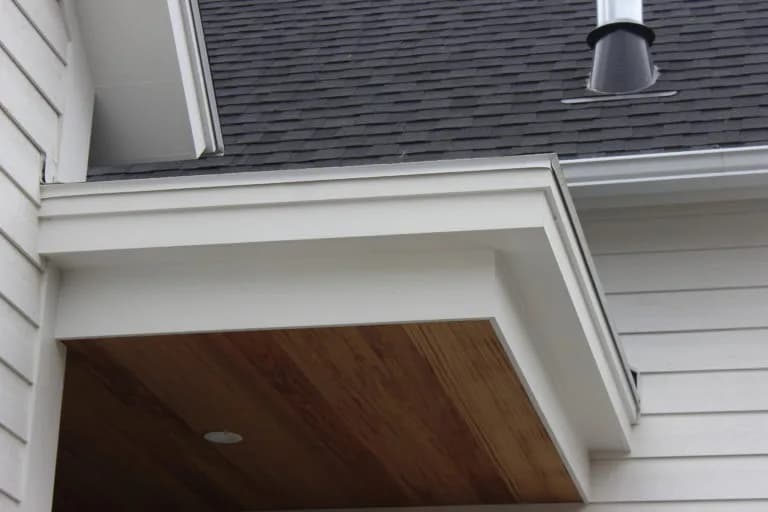
Roof Replacement in New Gloucester, Maine
Roof Replacement for New Gloucester homes from a family-owned Portland company. An owner measures on site and writes a fixed-price proposal.
- 5.0 · 8 Google reviews
- Fully licensed & insured
- Free estimates
- 20+ years combined experience
Roof Replacement for New Gloucester homes
Roofs on New Gloucester's connected farmhouses are a special case. A main house, an ell and a barn often step down in a line, and every place one roof meets another wall is a leak risk and a likely spot for ice to build. Snow slides from an upper roof onto a lower one and piles up, and the town's code office designs for a total snow load of 70 pounds per square foot, so a sagging ridge or cracked rafter on an old ell is worth a close look before new roofing goes on.
Replacement starts with a full tear-off so the decking can be inspected, especially on older roofs that may have been re-covered over earlier layers. Ice-and-water membrane goes at the eaves, in valleys and at every roof-to-wall joint, and step and counter flashing are replaced rather than reused. The town's handout treats re-roofing as maintenance that needs no permit when the structure is not altered; replacing rotted rafters or changing a pitch is a structural change that does. Cardinal Exteriors roofs in architectural asphalt, standing seam, metal shingle, cedar shake and low-slope membrane.
New Gloucester housing at a glance
Census estimates put New Gloucester at about 2,260 housing units with a median year built of 1991. About 11 percent of homes predate 1940 and roughly one in five predates 1960, but the largest share, about 31 percent, has been built in 2000 or later. Only about 15 percent date from 1960 to 1979, a much thinner mid-century layer than in neighboring Gray. Around 70 percent of units are single-family detached houses, and about 83 percent of occupied homes are owner-occupied. Seasonal homes are rare, about two dozen by the survey's count, so nearly every house here is lived in year-round. The oldest houses are notable: the village holds many wood-frame houses built before 1810 in Georgian and Federal styles, and Intervale Farm's circa-1811 brick farmhouse is joined to its barn by a string of wood-frame additions.
Weather and exposure in New Gloucester
New Gloucester is inland farm country, with the town center at roughly 364 feet and no salt exposure. The nearest long-term record is next door: NOAA's 1991-2020 normals for the Gray station list about 84 inches of snow a year, and January there averages near 22 degrees. The town's own code enforcement handout gives the figures it builds to, a total snow load of 70 pounds per square foot and a 100 mph wind speed. Open fields along the Intervale and around the farms let wind drive snow and rain against the long walls of connected farmhouses, and repeated freeze-thaw cycles work into any joint that holds water.
Permits and design review in New Gloucester
New Gloucester's Code Enforcement Officer, who also serves as plumbing inspector and health officer, issues building permits. Under Article 6.1.1 of the zoning ordinance, no structure may be erected, moved, added to or structurally altered without one. The office's handout says regular maintenance such as roofing, siding and window replacement needs no permit when it does not alter the structure. Decks do: the permit checklist asks for a foundation plan, framing cross sections and a signed plot plan with setbacks. The town's FAQ notes that work within 100 feet of a water body may need Maine DEP approval.
What roof replacement involves
A roof replacement strips the old roofing down to the deck, repairs what is underneath, and rebuilds the whole system: underlayment, ice and water protection at the eaves and valleys, flashing at chimneys and walls, ventilation, and the new roofing itself. Maine roofs carry snow for months and see ice dams at the eaves, so the parts you never see do most of the work. The site covers architectural asphalt shingles, metal, cedar shake and flat or low-slope roofing.
- Old roofing is torn off to the deck and hauled away, with the yard and plantings protected.
- Soft or delaminated sheathing is replaced before anything new goes down.
- Ice and water shield goes at the eaves, valleys and penetrations; synthetic underlayment covers the rest.
- Drip edge, step and counter flashing, and pipe boots are installed new.
- Ridge and soffit venting are balanced, then the new roofing is installed and the site cleaned with magnets.
Signs it is time
- Curling, cracked, or missing shingles and granules in the gutters
- Ice dams along the eaves or water stains on ceilings after thaws
- Daylight or damp sheathing visible in the attic
- Sagging roof lines or spongy spots underfoot
- A roof at or past the age its material was made for
What affects the price of roof replacement
- Roof area, pitch and complexity: valleys, dormers, skylights, chimneys
- Number of existing layers to remove
- Sheathing repair found after tear-off
- Material: asphalt, metal, cedar or low-slope membrane
- Ventilation and flashing upgrades
Every job is priced from a free on-site visit. Typical ranges for the trade are on our roofing page, and the details of this service are on the roof replacement overview.
More in New Gloucester and nearby
Back to the New Gloucester exterior services overview, or see every town on our Cumberland County service areas page.
Other exterior work in New Gloucester
- Asphalt Shingle Roofing in New Gloucester
- Metal Roofing in New Gloucester
- Deck Building in New Gloucester
- Composite & PVC Decks in New Gloucester
- Deck Replacement in New Gloucester
- Siding Replacement in New Gloucester
- Vinyl Siding Installation in New Gloucester
- James Hardie Fiber Cement Siding in New Gloucester
- Cedar Siding & Shingles in New Gloucester
- Window Replacement in New Gloucester
- Bay & Picture Windows in New Gloucester
Get a free roof replacement estimate in New Gloucester
Tell us about the house and what you want changed. One of the owners will call to set up a visit, measure, and write a fixed-price proposal. No pressure, no obligation.
Need it today?Call Mike (207) 408-5388
or Bob at (207) 252-0759