


Deck Replacement in Gray, Maine
Deck Replacement for Gray homes from a family-owned Portland company. An owner measures on site and writes a fixed-price proposal.
- Google reviews
- Fully licensed & insured
- Free estimates
- 20+ years combined experience
Deck Replacement for Gray homes
Many Gray decks date from the 1970s building wave or the subdivisions of the 1990s and 2000s, framed in pressure-treated lumber with a ledger nailed or lagged to the house, often with little flashing behind it. Decades on, the usual failures are rot at the ledger and rim joist where water collected, posts sitting on blocks or shallow piers that heave with frost, and guards and stairs built before today's rules for height, baluster spacing and riser size.
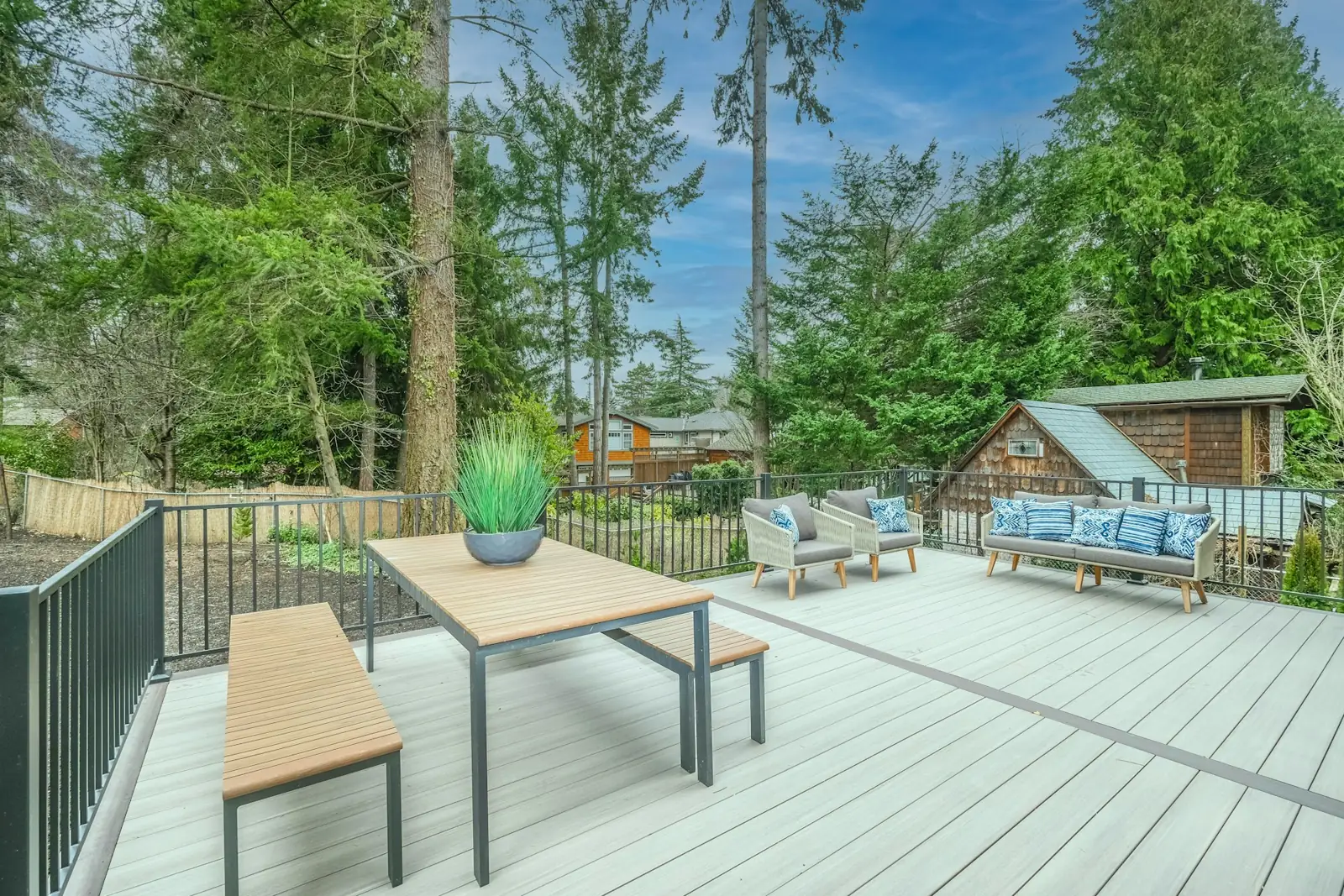
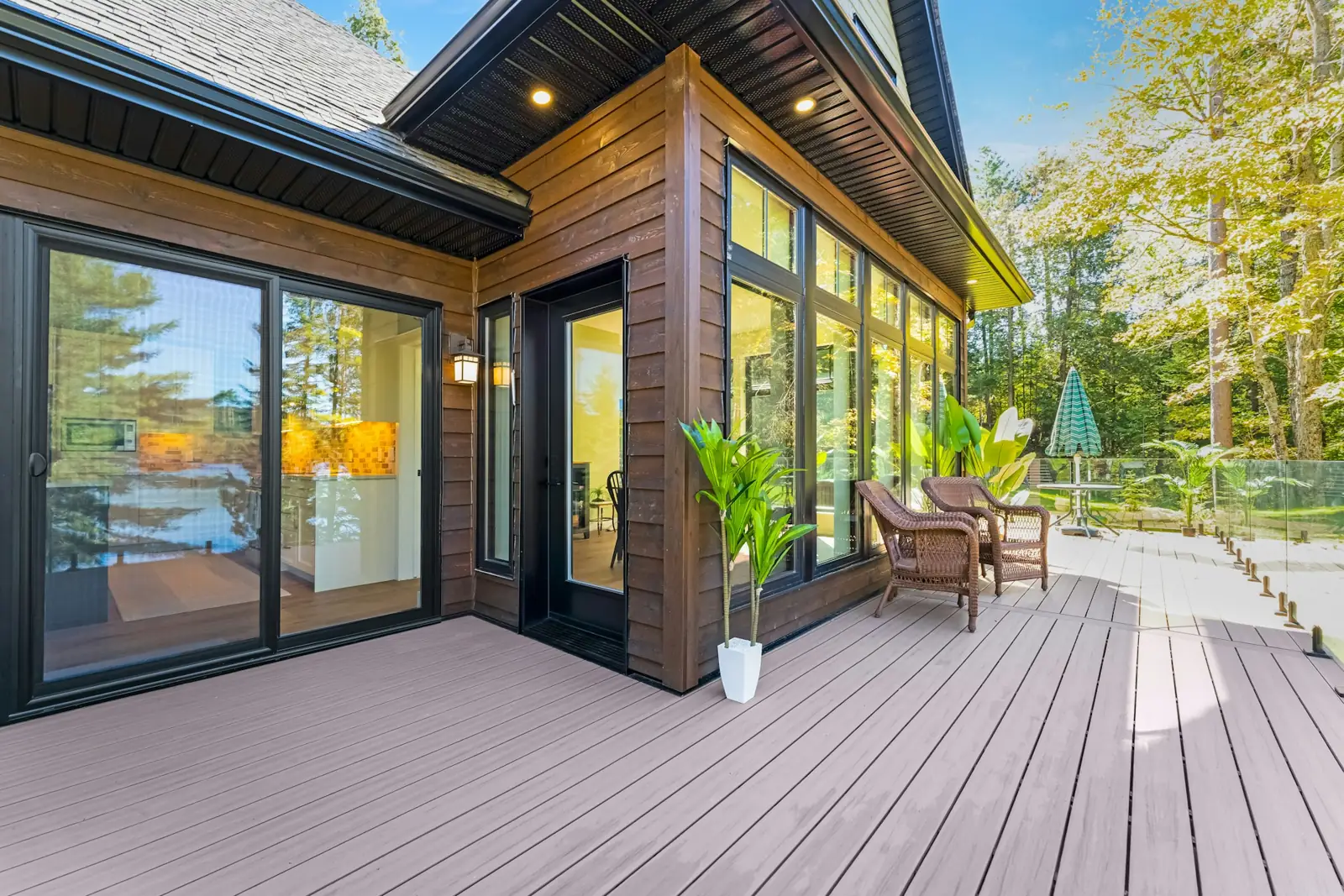
Cardinal Exteriors does not patch or repair decks. It removes the old deck and builds a new one from the footings up: new footings below frost, a properly flashed and through-bolted ledger or a freestanding frame, new beams and joists sized for Gray's snow, and new decking, rails and stairs. Because a replacement is new construction, expect to file Gray's residential building permit with a plot plan, and on lake lots, to check the shoreland rules before enlarging the old footprint. It is also the moment to rethink the layout, such as adding a landing or moving stairs toward the yard.
How a Deck Structure Is Built
- Footing — poured below Maine’s frost line so winter heaving cannot move it
- Post — carries the beam load down to the footing
- Beam — spans between posts and carries the outer ends of the joists
- Ledger — bolted to the house framing, with flashing that diverts water away from the wall
- Joists — span from the ledger to the beam, sized and spaced to the decking and the load
- Decking — the walking surface, fastened on top with spacing for drainage
Gray housing at a glance
The Census Bureau's American Community Survey estimates about 4,440 housing units in Gray, with a median year built of 1983. Roughly 12 percent predate 1940 and about 18 percent predate 1960, so most of the town is younger than its village center suggests. Two building waves stand out in the data: about 29 percent of homes went up between 1960 and 1979, and about 27 percent in 2000 or later, the years of subdivision growth off the state routes. Close to 78 percent of units are single-family detached houses, and about 82 percent of occupied homes are owner-occupied. The survey also counts roughly 630 seasonal units, around one in seven, which fits the camps and cottages along the town's lake frontage. The older stock runs to Capes and farmhouses, such as the Freeman Farm's circa-1812 Cape with its long ell and 1830s bank barn.
Permits and design review in Gray
Building permits in Gray go through the Community Development Department at the Henry Pennell Municipal Complex, 24 Main Street. The town's residential permit application lists decks as a structure type, asks for a plot plan and building plans, and asks for a Dig Safe number from calling 811 before digging. In the Village Center and Village Center Proper zoning districts, the design standards in Section 402.8.3 of the zoning ordinance, amended in 2021, require a Design Standard Certificate before a building permit is issued for development. Land within 250 feet of a great pond falls under Maine's mandatory shoreland zoning. Confirm what applies with the code office before work starts.
Weather and exposure in Gray
Gray is inland, with a town center about 256 feet above sea level, and it gets noticeably more snow than the coast. The town is home to the National Weather Service office that forecasts for western Maine and New Hampshire, and NOAA's 1991-2020 normals for the Gray station list about 84 inches of snow a year, with December, January and February each averaging roughly 18 to 21 inches. January averages about 22 degrees with a typical low near 14, and the coldest night of an average winter falls below zero. Salt air is not a factor here. The loads on a Gray exterior are freeze-thaw cycling, deep snow sitting on roofs and decks for weeks, ice dams at cold eaves, and wind across open fields and lake coves.
Gray at a Glance
What the housing stock and local code enforcement mean for a siding, window, roofing or deck job here.
8,269
Population (ACS estimate)
Median year built: 1983
Mostly vinyl or fiber-cement siding and insulated replacement windows from recent decades.
State Building & Energy Code (MUBEC)
Enforced — population over 4,000
EPA Lead-Safe Rule (pre-1978 homes)
Applies to at least 18% of homes here
Shoreland Zoning
Applies near the water
Permits
Gray Code Enforcement Office
Codes & Permits for Deck Replacement in Gray
In Gray, exterior-work permits come from the Gray Code Enforcement Office (Henry Pennell Municipal Complex, 24 Main Street, Gray, ME 04039, (207) 657-3339). With 8,269 residents, over 4,000, Gray is required to enforce the Maine Uniform Building and Energy Code (MUBEC).
- Because Maine's mandatory-enforcement threshold and permit rules are set at the municipal level (per 25 M.R.S. §2373 and each town's own ordinance), whether a 1:1 deck replacement needs a new permit varies by town; several nearby Maine towns' code offices treat any deck rebuild involving new footings or ledger work as requiring a permit even when replacing an existing deck's footprint — this should be confirmed per town rather than assumed exempt. mainelegislature.org
- A deck replacement/rebuild is a natural trigger to bring an older deck up to the current guard-height and footing/ledger-flashing requirements (R507/R312) even if the original deck predated those provisions, since a new permit application is typically reviewed against the code edition in effect at the time of the new work, not the deck's original construction date; confirm this 'bring up to current code' expectation with each town's code office, as no single Maine-specific source stating this policy uniformly was found in this research pass. up.codes
- Maine's Shoreland Zoning Act creates a regulated shoreland zone extending 250 feet (horizontal distance) from the normal high-water line of any great pond, river, or coastal wetland, and 75 feet from certain streams; the Act's stated purposes include protecting buildings and land from flooding/erosion and controlling water pollution, and it governs deck and other structure setbacks and the expansion of nonconforming structures within that zone (specific setback/expansion rules are set at the municipal-ordinance level under the state's model guidelines). maine.gov
- By Maine law (25 M.R.S. §2373), 'the code must be enforced in a municipality that has more than 4,000 residents' (per the most recent federal census); municipalities at or below that population are not required to adopt/enforce MUBEC but may opt in locally, per the state's own program page: 'All municipalities with a population greater than 4,000 are required, by statute, to enforce the MUBEC. Municipalities with a population under 4,000 may choose to enforce the MUBEC.' mainelegislature.org
How Cardinal Exteriors Handles Deck Replacement in Gray
- Every ledger we attach for a deck replacement job in Gray is flashed to Maine's adopted deck code, with corrosion-resistant metal or an approved nonmetallic alternative, not a bare lag bolt into siding.
- We set every Gray deck's footings below frost depth and size them to the actual load, following Maine's adopted residential code rather than a rule of thumb.
- Because Gray has coastal, lake or river frontage, Maine's Mandatory Shoreland Zoning Act may apply to work close to the water, which can affect setbacks on a rebuild.
- Gray's population (8,269) puts it above the threshold where Maine law requires full MUBEC enforcement, so this job is inspected against that code as well as the local permit.
- We file for deck replacement permits at the Gray Code Enforcement Office before work starts, not after.
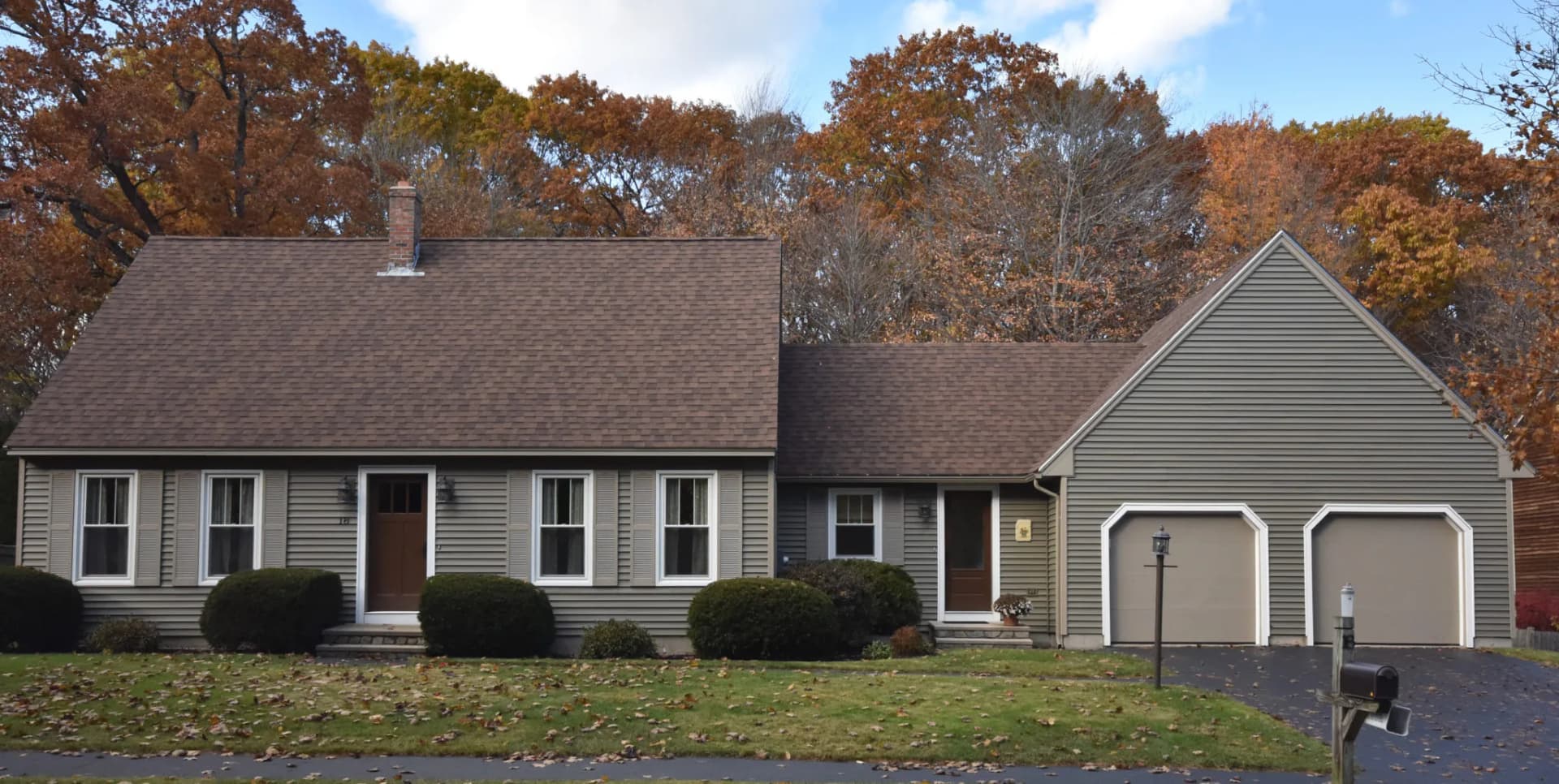
A Cape-style home along Lawrence Road in Gray.
Street View © Google
What deck replacement involves
When an old deck is soft, wobbly or pulling away from the house, a full replacement is treated as a new build: the old deck comes off, the footings and framing are built new, and the new surface, railings and stairs go on. That is the only way to deal with hidden rot at the ledger and frost-heaved footings, and it is how Cardinal Exteriors approaches it. It lets you change the size, shape and material at the same time.
- The existing deck is removed and disposed of, and the house wall behind the ledger is inspected.
- Rotted rim or sheathing behind the old ledger is repaired and the wall is flashed.
- New footings go below frost; new posts, beams and joists are framed.
- New decking, railings, stairs and landings are installed in the material you choose.
- Permits are pulled where required and the site is cleaned up.
Signs it is time
- Soft or spongy boards and joists
- A ledger pulling away from the house or rust-streaked fasteners
- Posts that have heaved, leaned or rotted at the base
- Railings that wobble or are lower than today's code expects
What affects the price of deck replacement
- Removal and disposal of the old deck
- Repairs to the house wall behind the ledger
- New size, height and shape
- Decking and railing materials
- Footing type and site access
Every job is priced from a free on-site visit. Typical ranges for the trade are on our deck building page, and the details of this service are on the deck replacement overview.
For a deeper walkthrough of materials, code details and photos, see our full Deck Replacement: When to Rebuild vs. Re-Deck guide.
More in Gray and nearby
Back to the Gray exterior services overview, or see every town on our service areas page.
Other exterior work in Gray
- Siding Replacement in Gray
- Vinyl Siding Installation in Gray
- James Hardie Fiber Cement Siding in Gray
- Cedar Siding & Shingles in Gray
- Window Replacement in Gray
- Bay & Picture Windows in Gray
- Roof Replacement in Gray
- Asphalt Shingle Roofing in Gray
- Metal Roofing in Gray
- Deck Building in Gray
- Composite & PVC Decks in Gray
Get a free deck replacement estimate in Gray
Tell us about the house and what you want changed. One of the owners will call to set up a visit, measure, and write a fixed-price proposal. No pressure, no obligation.
Need it today?Call Mike (207) 408-5388
or Bob at (207) 252-0759
More ways we can help
Google reviewsCompany
6Learn more about how we work, starting with…
Services
16We also cover related services across Greater Portland, such as…
Service Areas
38You will find our crews working in towns including…