
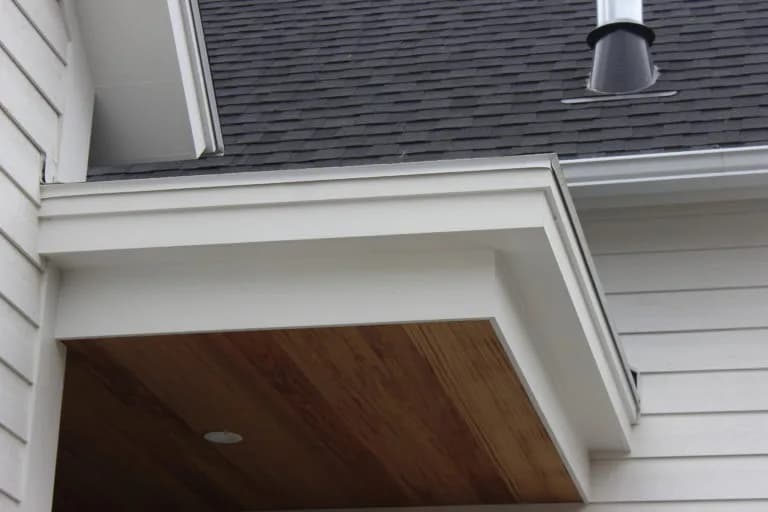
Roof Replacement in Gray, Maine
Roof Replacement for Gray homes from a family-owned Portland company. An owner measures on site and writes a fixed-price proposal.
- 5.0 · 8 Google reviews
- Fully licensed & insured
- Free estimates
- 20+ years combined experience
Roof Replacement for Gray homes
Roofs in Gray work harder than roofs on the coast. NOAA's normals for the Gray weather station put average snowfall at about 84 inches a year, and the town's inland cold keeps that snow on the roof for weeks at a time. Heat escaping from under-insulated attics in older Capes and 1970s ranches melts the underside of the snowpack, the water refreezes at the cold eaves, and the resulting ice dams push meltwater under the shingles and into ceilings and walls.
A tear-off is the time to fix that at the source. That means stripping to the deck, replacing any rotted sheathing, running ice-and-water membrane up from the eaves and through the valleys, and making sure soffit-to-ridge ventilation actually moves air. Gray's roofs are mostly straightforward gables and the long, low roofs of ranches, plus camp roofs under trees that collect needles and moss. Cardinal Exteriors replaces roofs in architectural asphalt shingles, standing seam or metal shingle, cedar shake, and flat or low-slope membrane on porches and additions, and an owner walks through the options with you on site before writing a fixed-price proposal.
Gray housing at a glance
The Census Bureau's American Community Survey estimates about 4,440 housing units in Gray, with a median year built of 1983. Roughly 12 percent predate 1940 and about 18 percent predate 1960, so most of the town is younger than its village center suggests. Two building waves stand out in the data: about 29 percent of homes went up between 1960 and 1979, and about 27 percent in 2000 or later, the years of subdivision growth off the state routes. Close to 78 percent of units are single-family detached houses, and about 82 percent of occupied homes are owner-occupied. The survey also counts roughly 630 seasonal units, around one in seven, which fits the camps and cottages along the town's lake frontage. The older stock runs to Capes and farmhouses, such as the Freeman Farm's circa-1812 Cape with its long ell and 1830s bank barn.
Weather and exposure in Gray
Gray is inland, with a town center about 256 feet above sea level, and it gets noticeably more snow than the coast. The town is home to the National Weather Service office that forecasts for western Maine and New Hampshire, and NOAA's 1991-2020 normals for the Gray station list about 84 inches of snow a year, with December, January and February each averaging roughly 18 to 21 inches. January averages about 22 degrees with a typical low near 14, and the coldest night of an average winter falls below zero. Salt air is not a factor here. The loads on a Gray exterior are freeze-thaw cycling, deep snow sitting on roofs and decks for weeks, ice dams at cold eaves, and wind across open fields and lake coves.
Permits and design review in Gray
Building permits in Gray go through the Community Development Department at the Henry Pennell Municipal Complex, 24 Main Street. The town's residential permit application lists decks as a structure type, asks for a plot plan and building plans, and asks for a Dig Safe number from calling 811 before digging. In the Village Center and Village Center Proper zoning districts, the design standards in Section 402.8.3 of the zoning ordinance, amended in 2021, require a Design Standard Certificate before a building permit is issued for development. Land within 250 feet of a great pond falls under Maine's mandatory shoreland zoning. Confirm what applies with the code office before work starts.
What roof replacement involves
A roof replacement strips the old roofing down to the deck, repairs what is underneath, and rebuilds the whole system: underlayment, ice and water protection at the eaves and valleys, flashing at chimneys and walls, ventilation, and the new roofing itself. Maine roofs carry snow for months and see ice dams at the eaves, so the parts you never see do most of the work. The site covers architectural asphalt shingles, metal, cedar shake and flat or low-slope roofing.
- Old roofing is torn off to the deck and hauled away, with the yard and plantings protected.
- Soft or delaminated sheathing is replaced before anything new goes down.
- Ice and water shield goes at the eaves, valleys and penetrations; synthetic underlayment covers the rest.
- Drip edge, step and counter flashing, and pipe boots are installed new.
- Ridge and soffit venting are balanced, then the new roofing is installed and the site cleaned with magnets.
Signs it is time
- Curling, cracked, or missing shingles and granules in the gutters
- Ice dams along the eaves or water stains on ceilings after thaws
- Daylight or damp sheathing visible in the attic
- Sagging roof lines or spongy spots underfoot
- A roof at or past the age its material was made for
What affects the price of roof replacement
- Roof area, pitch and complexity: valleys, dormers, skylights, chimneys
- Number of existing layers to remove
- Sheathing repair found after tear-off
- Material: asphalt, metal, cedar or low-slope membrane
- Ventilation and flashing upgrades
Every job is priced from a free on-site visit. Typical ranges for the trade are on our roofing page, and the details of this service are on the roof replacement overview.
More in Gray and nearby
Back to the Gray exterior services overview, or see every town on our Cumberland County service areas page.
Other exterior work in Gray
- Asphalt Shingle Roofing in Gray
- Metal Roofing in Gray
- Deck Building in Gray
- Composite & PVC Decks in Gray
- Deck Replacement in Gray
- Siding Replacement in Gray
- Vinyl Siding Installation in Gray
- James Hardie Fiber Cement Siding in Gray
- Cedar Siding & Shingles in Gray
- Window Replacement in Gray
- Bay & Picture Windows in Gray
Get a free roof replacement estimate in Gray
Tell us about the house and what you want changed. One of the owners will call to set up a visit, measure, and write a fixed-price proposal. No pressure, no obligation.
Need it today?Call Mike (207) 408-5388
or Bob at (207) 252-0759