
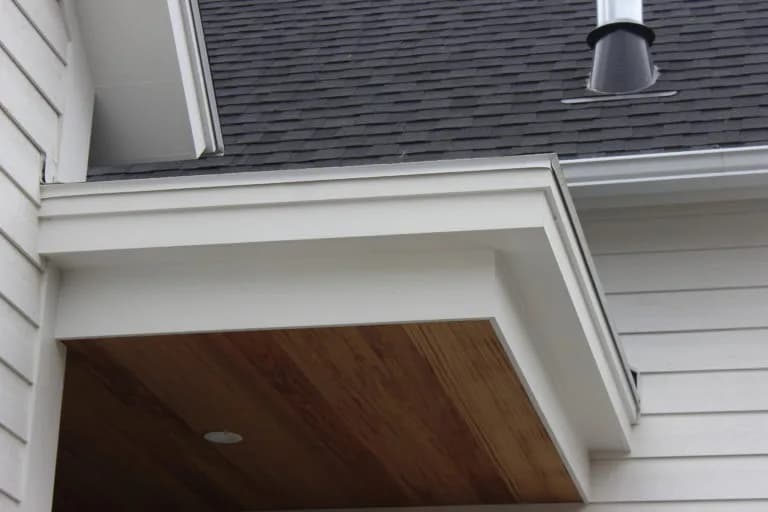
Roof Replacement in North Yarmouth, Maine
Roof Replacement for North Yarmouth homes from a family-owned Portland company. An owner measures on site and writes a fixed-price proposal.
- 5.0 · 8 Google reviews
- Fully licensed & insured
- Free estimates
- 20+ years combined experience
Roof Replacement for North Yarmouth homes
Most North Yarmouth roofs cover the colonials and capes built from the 1980s onward, and a lot of them are still on their first or second layer of three-tab shingles. The roofs that fail first are the north-facing slopes under tall pines and oaks, where needles hold moisture and moss lifts shingle edges, and the eaves over under-insulated attics, where ice dams form after a thaw and a hard freeze. Older farmhouses bring their own issues: long ell roofs, attached barns and valleys where several additions meet.
A proper replacement removes all layers, replaces soft decking, lays ice barrier at the eaves and valleys and corrects ventilation so the attic stays cold. Next door, Yarmouth's building code enters ice shield underlayment as required in its statewide-code design table, and the same winter conditions apply on these hills. Snow that drifts off open fields loads the leeward side of a roof unevenly, so decking and fastening should be checked there. Cardinal Exteriors replaces roofs in architectural asphalt shingles, standing seam and metal shingle, cedar shake and low-slope membrane, and an owner writes the fixed-price proposal.
North Yarmouth housing at a glance
The Census Bureau's 2020-2024 American Community Survey estimates about 1,600 homes in North Yarmouth, with a median year built of 1983, a decade newer than Yarmouth next door. About 94 percent are single-family detached and about 87 percent of occupied homes are owner-occupied, and only about a dozen units are held for seasonal use. Roughly 13 percent of homes predate 1940 and about 21 percent predate 1960, while about 24 percent date from 1960 to 1979 and about 23 percent from 2000 or later. The 2018 comprehensive plan counts 319 homes built in the 1990s alone, the town's peak decade, and notes that more than 135 houses shown on an 1871 town map are still standing, many of them restored farmhouses and capes along the old roads.
Weather and exposure in North Yarmouth
This is an inland town, out of reach of the salt spray that works on houses along the Casco Bay shore in Yarmouth. Weather here comes instead from elevation and open ground. The 2018 comprehensive plan puts elevations between 60 feet, where Pratt's Brook leaves town, and 400 to 440 feet at the top of Walnut Hill and the upper slopes of Bruce Hill. About 17 percent of the town is open field, so hilltop houses facing hayfields take full wind in winter storms, while the 63 percent that is forest keeps other lots shaded and damp. Portland, the nearest long-term weather record, averages about 69 inches of snow a year, and freeze-thaw cycles run from November into April.
Permits and design review in North Yarmouth
The North Yarmouth Code Enforcement Office at the Town Office, 10 Village Square Road, issues building permits and runs an online permitting portal. The town's permit guide lists a building permit as required for a deck, an addition, demolition and any structural change, and asks owners to call the office about work not on the list. Demolishing a building constructed before 1900 requires written notice to the North Yarmouth Historical Society at least 30 days ahead. Near the Royal River, Chandler Brook, Knight's Pond and the Deer Brook wetland, the Land Use Ordinance's Residential Shoreland and Resource Protection districts add structure setbacks.
What roof replacement involves
A roof replacement strips the old roofing down to the deck, repairs what is underneath, and rebuilds the whole system: underlayment, ice and water protection at the eaves and valleys, flashing at chimneys and walls, ventilation, and the new roofing itself. Maine roofs carry snow for months and see ice dams at the eaves, so the parts you never see do most of the work. The site covers architectural asphalt shingles, metal, cedar shake and flat or low-slope roofing.
- Old roofing is torn off to the deck and hauled away, with the yard and plantings protected.
- Soft or delaminated sheathing is replaced before anything new goes down.
- Ice and water shield goes at the eaves, valleys and penetrations; synthetic underlayment covers the rest.
- Drip edge, step and counter flashing, and pipe boots are installed new.
- Ridge and soffit venting are balanced, then the new roofing is installed and the site cleaned with magnets.
Signs it is time
- Curling, cracked, or missing shingles and granules in the gutters
- Ice dams along the eaves or water stains on ceilings after thaws
- Daylight or damp sheathing visible in the attic
- Sagging roof lines or spongy spots underfoot
- A roof at or past the age its material was made for
What affects the price of roof replacement
- Roof area, pitch and complexity: valleys, dormers, skylights, chimneys
- Number of existing layers to remove
- Sheathing repair found after tear-off
- Material: asphalt, metal, cedar or low-slope membrane
- Ventilation and flashing upgrades
Every job is priced from a free on-site visit. Typical ranges for the trade are on our roofing page, and the details of this service are on the roof replacement overview.
More in North Yarmouth and nearby
Back to the North Yarmouth exterior services overview, or see every town on our Cumberland County service areas page.
Other exterior work in North Yarmouth
- Asphalt Shingle Roofing in North Yarmouth
- Metal Roofing in North Yarmouth
- Deck Building in North Yarmouth
- Composite & PVC Decks in North Yarmouth
- Deck Replacement in North Yarmouth
- Siding Replacement in North Yarmouth
- Vinyl Siding Installation in North Yarmouth
- James Hardie Fiber Cement Siding in North Yarmouth
- Cedar Siding & Shingles in North Yarmouth
- Window Replacement in North Yarmouth
- Bay & Picture Windows in North Yarmouth
Get a free roof replacement estimate in North Yarmouth
Tell us about the house and what you want changed. One of the owners will call to set up a visit, measure, and write a fixed-price proposal. No pressure, no obligation.
Need it today?Call Mike (207) 408-5388
or Bob at (207) 252-0759