
James Hardie Fiber Cement Siding in Cumberland, Maine
James Hardie Fiber Cement Siding for Cumberland homes from a family-owned Portland company. An owner measures on site and writes a fixed-price proposal.
- 5.0 · 8 Google reviews
- Fully licensed & insured
- Free estimates
- 20+ years combined experience
James Hardie Fiber Cement Siding for Cumberland homes
For houses that need to last in both salt air and deep cold, James Hardie fiber cement is a strong choice in Cumberland. The boards are made from cement, sand and cellulose fiber, so they do not rot, resist the freeze and thaw cycles that crack paint on wood, and hold a baked-on finish much longer than site-painted clapboards. That finish matters on the Foreside, where a coat of paint on the bay side can fail in a few seasons.
Fiber cement also reads as painted wood from the street, which suits the older homes around Cumberland Center and the farmhouses scattered along the rural roads of West Cumberland, some of them among the 217 houses the town counts from before 1900. Narrow-reveal lap boards, shingle panels and smooth trim boards can match traditional proportions. The boards are noncombustible, a useful property for houses that back onto wooded conservation land such as the Town Forest or Rines Forest. They are heavy and must be cut with dust control, and every joint, butt end and roof-to-wall line needs the manufacturer's flashing and clearance details, especially where snow piles against the wall.
Cumberland housing at a glance
Census estimates for 2020 to 2024 put Cumberland at about 3,300 housing units, with a median year built of 1984. About 15 percent predate 1940, roughly 24 percent were built between 1960 and 1979, about 26 percent in the 1980s and 1990s, and about 29 percent in 2000 or later. Around 91 percent of occupied homes are owner-occupied, and about 82 percent of units are single-family detached houses; only about 60 are held for seasonal use. The town's 2025 draft comprehensive plan counts 27 houses built before 1800 and another 190 built during the 1800s, about 7 percent of the stock. Most recent building has come as conservation or cluster subdivisions, such as the 72 homes of Mineral Springs in West Cumberland, plus condominiums and apartments near Route 1.
Weather and exposure in Cumberland
Cumberland has no official weather station; the long-term record for the area comes from Portland International Jetport, where 1991 to 2020 normals put average snowfall at about 69 inches a year and February lows around 17 degrees. The town rises from sea level on the Foreside to about 184 feet at Cumberland Center, so the inland villages see similar snow but little salt. Houses on the Foreside, between Route 1 and the bay, take wind and salt spray from northeast storms, and the draft comprehensive plan lists storm surge and rising seas as coastal concerns. Inland, freeze and thaw cycles and shade from woods do most of the damage to roofs and wood.
Permits and design review in Cumberland
The Cumberland Code Enforcement Office handles building permits and inspections, which it schedules Monday through Thursday, and applications can be sent by email. Construction must meet the 2021 International Residential Code, the 2021 International Building Code and the 2021 International Energy Conservation Code under the Maine Uniform Building and Energy Code. The Shoreland Overlay District generally reaches 250 feet from rivers, streams, saltwater and associated wetlands, and 75 feet from certain streams; any building permit there needs a Shoreland Zoning Permit first or alongside it. The town has no historic preservation ordinance, though the draft comprehensive plan asks the council to consider one.
What James Hardie fiber cement siding involves
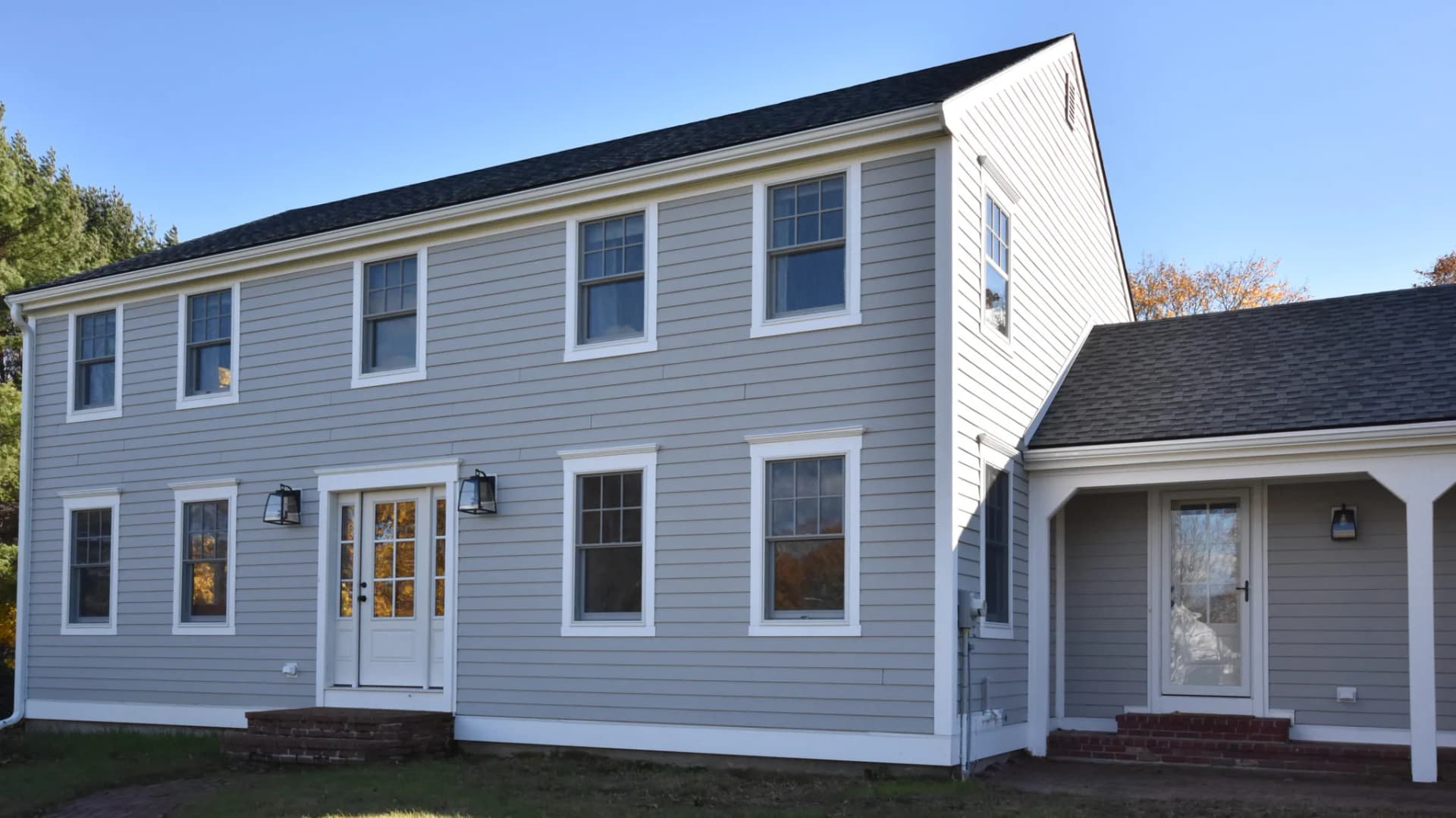
Fiber cement is a mix of cement, sand and cellulose fiber pressed into planks, shingles and panels. It does not rot, insects do not eat it, it will not burn, and factory-applied finishes hold color far longer than site-painted wood. It is heavier and more exacting to install than vinyl, which is exactly why installation quality shows. The Back Cove home on this site was re-sided with a complete James Hardie package of wood-grain plank.
- Walls are stripped, repaired and wrapped, with flashing at every opening and roof-to-wall joint.
- Boards are cut with dust-controlled tools and fastened to the manufacturer's nailing schedule.
- Required clearances are held above roofs, decks and grade so the ends never sit in water or snow.
- Butt joints get flashing behind them, and cut ends are sealed or primed as the manufacturer specifies.
- Trim, caulk lines and touch-up are finished so the pre-finished color stays uniform.
Signs it is time
- You want the look of painted clapboard without the paint cycle
- Wood siding keeps rotting at the bottom courses and around trim
- The house sits in wind and salt exposure that punishes other materials
- You want a non-combustible exterior
What affects the price of James Hardie fiber cement siding
- Product line and profile: lap plank, shingle, panel or board-and-batten
- Pre-finished color versus site painting
- Trim package and detailing
- Tear-off, sheathing repair and house height
- Number of windows, doors and corners to flash and trim
Every job is priced from a free on-site visit. Typical ranges for the trade are on our siding page, and the details of this service are on the James Hardie fiber cement siding overview.
Cardinal Exteriors projects in Cumberland
More in Cumberland and nearby
Back to the Cumberland exterior services overview, or see every town on our Cumberland County service areas page.
Other exterior work in Cumberland
- Cedar Siding & Shingles in Cumberland
- Window Replacement in Cumberland
- Bay & Picture Windows in Cumberland
- Roof Replacement in Cumberland
- Asphalt Shingle Roofing in Cumberland
- Metal Roofing in Cumberland
- Deck Building in Cumberland
- Composite & PVC Decks in Cumberland
- Deck Replacement in Cumberland
- Siding Replacement in Cumberland
- Vinyl Siding Installation in Cumberland
Fiber Cement Siding in nearby towns
Get a free James Hardie fiber cement siding estimate in Cumberland
Tell us about the house and what you want changed. One of the owners will call to set up a visit, measure, and write a fixed-price proposal. No pressure, no obligation.
Need it today?Call Mike (207) 408-5388
or Bob at (207) 252-0759